EMUNO Therapeutics: the innate immune system as a new approach to cancer treatment
Activation of macrophages: a key factor in the fight against colorectal cancer
The mobilisation of the body’s own immune system through immune checkpoint inhibitors has revolutionised cancer therapy. However, the majority of solid tumours are able to evade immune surveillance. These so-called 'cold' tumours contain too few immune cells to respond effectively to current immunotherapies. This is where the Freiburg-based biotech start-up EMUNO Therapeutics GmbH comes in. As a spin-off from the University of Freiburg and University Medical Center Freiburg, the company aims to transform immunologically ‘cold’ tumours into 'hot' tumours that can be recognised and attacked by the immune system. Founded by Dr. Emilia Neuwirt, Prof. Dr. Olaf Groß and Dr. Andreas Vogt, EMUNO Therapeutics is developing a novel therapeutic approach to improve the treatment of colorectal cancer and other solid tumours.
Until now, research in immunooncology has primarily focused on the adaptive immune system, especially the activation of T cells. In advanced colorectal cancer, however, this therapeutic approach is usually ineffective because the tumour microenvironment has changed. The tumour has transformed from a 'hot' into a 'cold' tumour. "A 'hot' tumour typically contains large numbers of T cells from the adaptive immune system," explains Dr. Emilia Neuwirt, pharmacist and founder of EMUNO Therapeutics. Immunotherapies reactivate these T cells, enabling them to recognise and destroy cancer cells. "In advanced colorectal cancer, however, the vast majority of tumours no longer contain sufficient T cells to serve as targets for immunotherapy," she says. "As a result, these therapies are largely ineffective." Approximately 95 percent of advanced colorectal cancers are classified as 'cold' tumours, meaning they are largely inaccessible to the adaptive immune system. "We therefore needed an approach that targets a different type of immune cell - one that is actually present within the tumour," says Neuwirt.
The innate immune system offers a new approach
 By harnessing the power of macrophages, pharmacist Dr. Emilia Neuwirt aims to convert 'cold' colorectal tumours into 'hot' tumours, enabling the body’s own immune system to recognise and attack them. © Dr. Emilia Neuwirt, private
The Freiburg-based start-up EMUNO Therapeutics is shifting its focus to the innate immune system, the evolutionarily more ancient arm of the immune system. "In a 'cold' tumour, we find large numbers of macrophages, which are cells of the innate immune system," explains pharmacist Dr. Emilia Neuwirt. "However, these macrophages are in a dormant state. To activate them, we first need to wake them up." Within the microenvironment of 'cold' tumours, targeted modulation of innate immune signalling pathways appears to trigger this crucial shift. By activating macrophages to produce immunogenic signals, 'cold' tumours can be converted into 'hot' tumours, making them visible to the adaptive immune system. A key advantage of this approach is that, unlike T cells, macrophages do not depend on highly specific mutated tumour surface proteins – known as neoantigens – for tumour recognition.
"We can simply stimulate the macrophages from the outside, and they then initiate an immune response independently of neoantigens," says the founder. However, to activate the macrophages, the researchers first need a suitable therapeutic agent.
From basic research to start-up
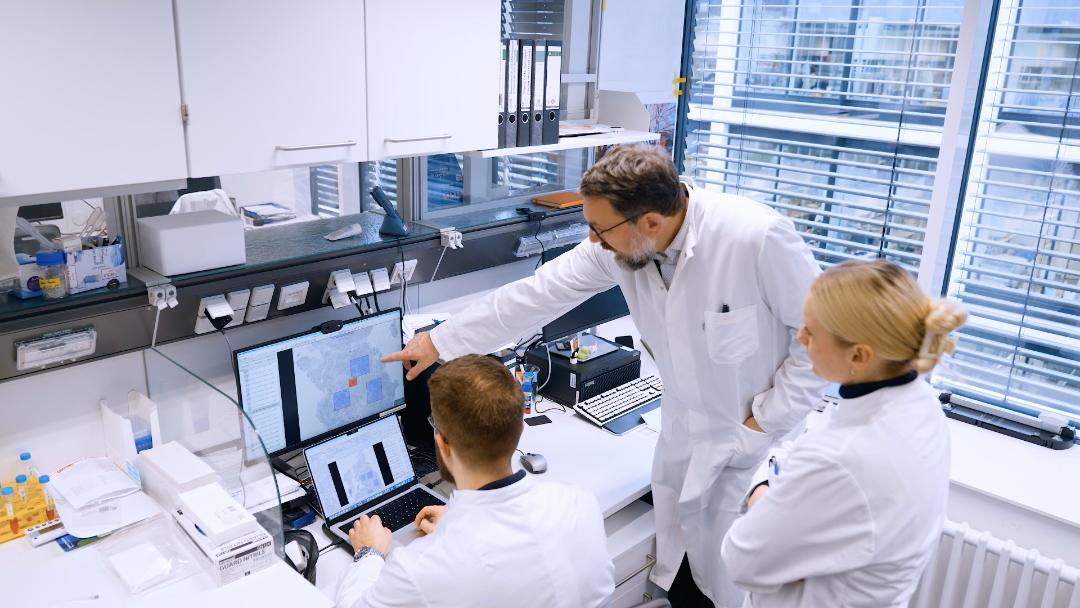 EMUNO founders Dr. Emilia Neuwirt and Prof. Dr. Olaf Groß with a member of their research team examining tumour sections from a preclinical study aimed at evaluating the efficacy of EMT-224. © University Hospital Center Freiburg
Neuwirt discovered this compound during a high-throughput screening process conducted as part of her PhD research in Prof. Dr. Olaf Groß’s laboratory. "At the time, we were searching for novel activators of a signalling pathway in macrophages with the aim of identifying new research tools and ultimately gaining a better understanding of this pathway," she recalls. To achieve this, she developed a high-throughput screening assay and analysed approximately 50,000 molecules. From this extensive library, two highly active chemical candidates were identified, both of which proved to be well suited for the precise modulation of the immune response. These discoveries formed the basis for the development of EMT-224, a synthetic small-molecule drug candidate.
"We realised early on that these novel compounds were highly specific and effective. It soon became clear that their potential extended far beyond that of mere research tools and that they also had significant therapeutic potential - for example, in cancer immunotherapy," says Neuwirt. This realisation led to the filing of a patent application while she was still completing her PhD and ultimately to the founding of EMUNO Therapeutics in 2024 together with her former PhD supervisor and now co-founder, Prof. Dr. Olaf Groß, as well as physician and financial strategist Dr. Andreas Vogt. Today, the start-up has a team of six.
EMT-224 as a specific switch
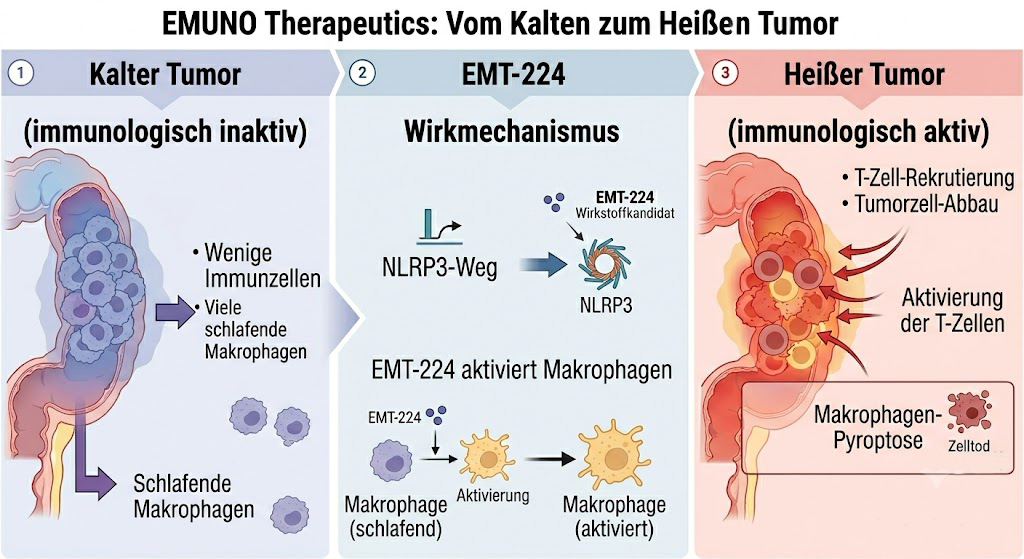 The laboratory-synthesised compound EMT-224 can 'wake up' dormant macrophages, enabling them to convert 'cold' tumours into 'hot' tumours. This, in turn, activates T cells and enables them to attack the tumour. © AI generated (gemini)
The biological uniqueness of EMT-224 lies in its ability to selectively activate the NLRP3 signalling pathway within the innate immune system. Whereas established immunotherapies aim to overcome tumour-induced immune evasion by reactivating T cells of the adaptive immune system, EMT-224 acts as a highly specific activator of the NLRP3 inflammasome – a multiprotein complex that normally serves as a molecular 'alarm system' in response to cellular stress or tissue damage.
"Because our compound is based on a universal mechanism, we can activate dormant macrophages irrespective of the underlying tumour biology," the researcher explains. Activation of the NLRP3 inflammasome by EMT-224 produces a strong but highly specific immune signal that naturally subsides over time. Neuwirt explains: "This allows us to activate the immune system, but because the response is triggered by an external stimulus, it is transient, thereby preventing persistent overstimulation of the immune system." This transient activation reshapes the local tumour microenvironment by overcoming existing immunosuppressive barriers. The activated macrophages release cytokines that recruit adaptive immune cells, including T cells, which infiltrate the tumour and selectively eliminate tumour cells. The activated macrophages subsequently undergo pyroptosis, a form of programmed inflammatory cell death, thereby terminating the signalling cascade. This self-limiting mechanism may help reduce the risk of autoimmune reactions.
Application to treatment-resistant tumours
EMT-224 could potentially be used in combination with other therapies, for example to render 'cold' tumours responsive to immune checkpoint inhibitors. However, Neuwirt also sees evidence of efficacy as a monotherapy in preclinical models. One of the aims is to make it as simple as possible to administer. As a small-molecule drug candidate, EMT-224 could potentially be administered orally as a tablet and is expected to clear from the body within two to three hours.
Over the next few years, the researchers aim to demonstrate the safety of EMT-224 and establish a GMP-compliant manufacturing process to prepare the drug candidate for clinical development and first-in-human trials. In the long term, they hope to extend this universal approach to NLRP3 activation beyond colorectal cancer to a broad range of treatment-resistant solid tumours. "Our strategy is to develop drug candidates through the preclinical and early clinical stages before outlicensing them to larger pharmaceutical companies," explains Neuwirt. "We already have additional targets in our pipeline, and we see ourselves as a kind of drug incubator." Late-stage clinical development and regulatory approval would then be undertaken by pharmaceutical partners that have the necessary expertise and resources. In 2025, EMUNO Therapeutics was awarded a €2.5 million (European Innovation Council (EIC) Transition Grant from the European Commission.
