Heart surgery without a heart-lung machine
HeartGate: the safe gateway to the heart
For patients with advanced heart failure, a mechanical heart pump can offer a life-saving alternative to heart transplants. As part of the HeartGate project, researchers at the University Medical Center Freiburg are developing an innovative implantation system to insert a heart pump directly into a beating heart. By eliminating the need for a heart-lung machine, this approach has the potential to make the procedure faster, less invasive and safer for patients.
Cardiovascular diseases are the leading cause of death in Germany, with heart failure ranking third among the causes of cardiovascular mortality.1) Heart failure can develop as a consequence of different underlying conditions, including coronary heart disease, valvular heart disease and hypertension. In patients with advanced heart failure, the heart may become so severely weakened that it can no longer supply vital organs with sufficient blood, despite medical treatment. In such cases, heart transplantation may offer the best therapeutic option. However, due to a persistent shortage of donor organs, mechanical circulatory support systems have become an important alternative, providing life-saving support for patients with severe heart failure.
Invasive implantation procedure
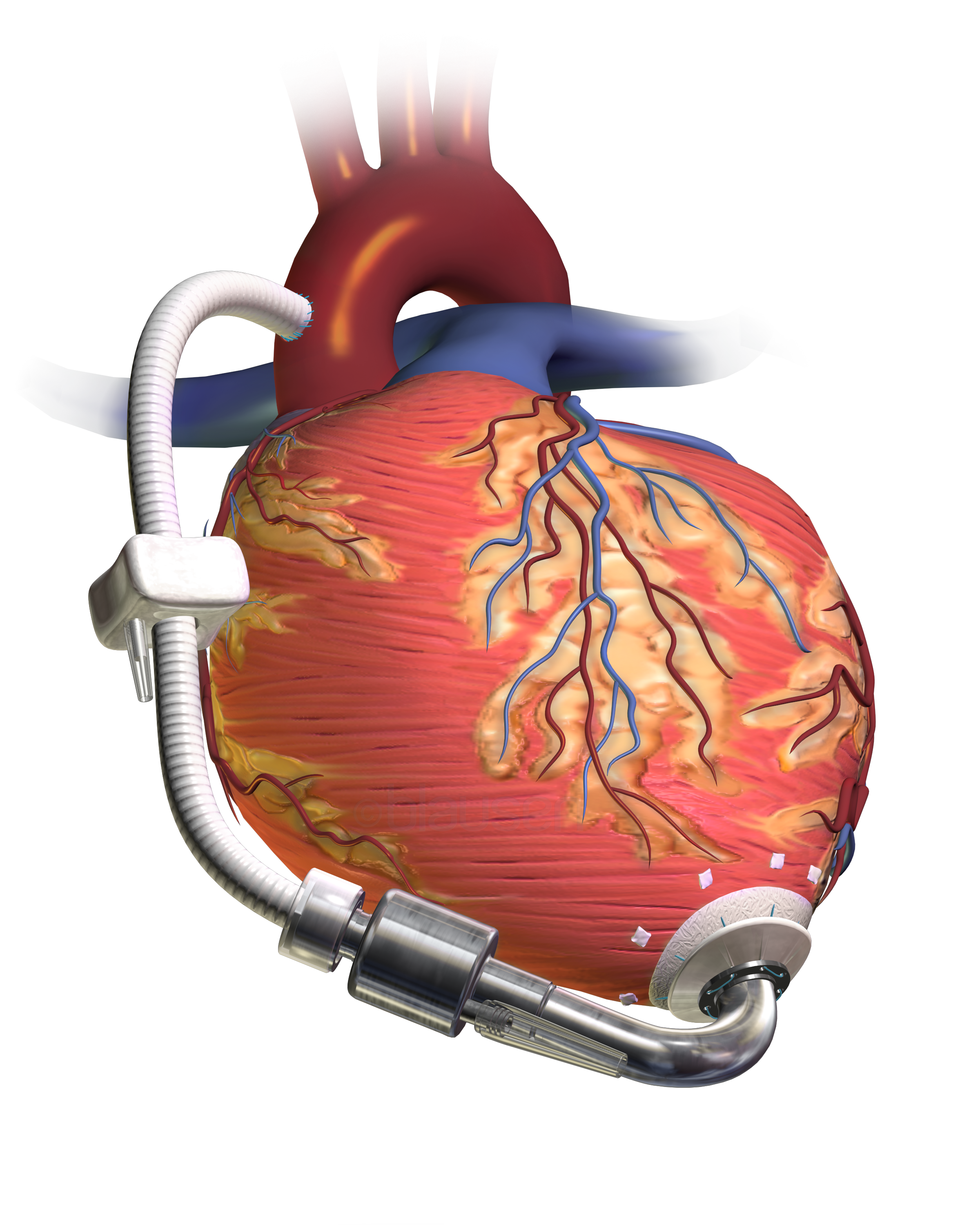 The mechanical heart pump is implanted at the apex of the left ventricle, where it draws blood from the heart and pumps it directly into the aorta, bypassing the heart’s natural pumping function. Source: Blausen 0621 LVAD, Blausen Medical Communications, Inc., CC BY 3.0 (https://creativecommons.org/licenses/by/3.0) via Wikimedia Commons https://commons.wikimedia.org/wiki/File:Blausen_0621_LVAD.png
"Originally, mechanical cardiac assist devices were primarily used as a bridge to heart transplantation. These days they are used as long-term, definitive treatment for the majority of patients," explains Dr. Florian Meißner from the Department of Cardiac, Thoracic and Vascular Surgery and Aortic Medicine at the University Medical Center Freiburg. These devices, known as left ventricular assist devices (LVADs), are implanted at the apex of the left ventricle. They draw blood from the left ventricle and pump it through a vascular graft directly into the aorta, bypassing the heart’s natural outflow pathway and supporting systemic circulation.
Although LVADs can significantly improve patients’ quality of life, they also limit some daily activities. The pump is powered via a cable that passes through the abdominal wall, creating a persistent risk of infection at the exit site. In addition, patients have to carry an external power supply with them everywhere they go and are generally unable to swim or take baths in case water enters the driveline exit site.
Implanting a mechanical heart pump typically requires major open-chest surgery. During the procedure, an opening approximately two centimetres in diameter is created at the apex of the left ventricle, into which the pump’s inflow cannula – a hollow cylindrical component – is inserted. Because the heart continues to beat during this stage of the procedure, there is a risk of potentially life-threatening bleeding. To minimise this risk, surgeons typically use a heart-lung machine, also known as cardiopulmonary bypass (CPB), to temporarily take over heart and lung function. "However, the use of cardiopulmonary bypass places additional stress on the body and is associated with increased risk of coagulation disorders, kidney failure and neurological complications," explains Dr. Meißner. To address these challenges, Dr. Meißner and the junior research team he leads are developing an innovative implantation technique within the research group headed by cardiac surgeon Prof. Dr. Wolfgang Bothe. Their aim is to enable the implantation of mechanical heart pumps without the need for cardiopulmonary bypass.
A valve as a gateway to the heart
 The HeartGate team: Manuela Schön, Franziska Hörth, Dr. Florian Meißner, Mustafa Sibaa (from left to right) © HeartGate
The innovative approach pursued by the HeartGate – Gateway to the Heart project, launched in 2024, has attracted significant recognition and support. As a result, in 2025, the research team was awarded over €4 million in funding by the German Federal Ministry of Research, Technology and Space (BMFTR) under its GO-Bio next programme. "We have developed a specialised implantation kit featuring an innovative sealing mechanism that automatically closes the opening in the heart once the cutting instrument has been withdrawn," explains Manuela Schön, deputy project leader. "This seal prevents blood from leaking out and air from entering the beating heart." The mechanical heart pump’s inflow cannula can then be inserted directly through the sealed opening, enabling implantation while the heart continues to beat.
HeartGate does not interfere with the heart’s pumping function but is designed exclusively to facilitate the surgical implantation procedure. "Our device is only used temporarily during surgery and does not remain in the body. It may therefore be classified in a lower risk category than permanent implants and potentially simplify the regulatory approval process," explains Schön. Given the complex regulatory requirements governing medical devices, the medical technology engineer is currently studying for a part-time Master’s degree in Regulatory Affairs at Furtwangen University alongside her professional responsibilities. The research team also benefits from financial and technical support provided through the Else Kröner-Fresenius Foundation’s Translatorik funding programme, which supports the translation of medical research into clinical applications.
Universal compatibility for greater patient safety
The proof of concept has already been successfully demonstrated, and the prototype is currently undergoing preclinical development. During the three-year BMFTR funding period, Schön and Meißner aim to establish a spin-off company, with Prof. Dr. Wolfgang Bothe providing guidance and mentorship. To support further development and an eventual market launch, the team plans to secure additional funding through research grants and private investors.
As the implantation kit is compatible with several commonly used heart pumps, the researchers anticipate considerable demand for the technology. According to Dr. Meißner, the aim is to give cardiac surgeons the flexibility to decide, based on each patient’s individual clinical circumstances, whether to perform the procedure with or without cardiopulmonary bypass (CPB). The long-term objective is to enable as many heart pump implantations as possible to be performed using HeartGate, thereby reducing the need for a heart-lung machine. However, cardiopulmonary bypass would still be necessary in cases such as heart valve surgery that require additional cardiac procedures.
The use of HeartGate could significantly reduce the physical burden on patients by making heart pump implantation less invasive and quicker to perform. This could, in turn, reduce the risk of complications and shorten stays in both intensive care and normal hospital wards. Overall, the researchers anticipate potential cost savings in the tens of thousands of euros per procedure. These savings would need to be weighed against the cost of HeartGate itself, which is designed as a single-use medical device.
By potentially reducing the risks associated with surgery, HeartGate could also make heart pump implantation a viable treatment option for patients who have previously been deemed unsuitable for the procedure due to factors such as age or existing medical conditions.
