Prime Vector Technologies is developing a new vaccine platform
The ORF platform – one virus, many possibilities
Many vaccines effectively deliver an antigen to the desired target site. But what if, at the same time, the immune system could be specifically orchestrated to build broad and comprehensive protection? This idea led to the development of a novel vector platform based on the Orf virus. The work was carried out by the Tübingen-based start-up Prime Vector Technologies. Proof of concept has already been demonstrated, and the path towards clinical trials is now clearly mapped out. Yet the potential of the platform extends far beyond 'just' a new vaccine.
Poxviruses are not usually associated with anything positive. Yet it may be time to rethink this perception, as many viruses are capable of far more than simply causing disease. This is also true of the Orf virus (ORFV), a member of the Poxviridae family, which includes the variola virus, the pathogen that causes smallpox. Unlike the variola virus, ORFV only replicates to a limited extent in humans and is considered relatively harmless: although it can cause localised skin infections, these generally heal without any lasting effects. However, in its primary hosts, sheep and goats, the infection is generally more severe.
Yet it is precisely this ability of viruses to introduce genetic information into cells that makes them valuable tools in modern medicine. Molecular biology began harnessing this principle for medical applications decades ago, initially in gene therapy and later also in vaccines. Viral vectors gained widespread public attention in 2021 with the introduction of COVID-19 vaccines based on adenoviruses. These vectors are derived from genetically modified adenoviruses, which commonly cause respiratory infections. However, there is a drawback associated with this: many people have already been exposed to adenoviruses and may therefore have pre-existing immunity, which can reduce the effectiveness of repeated administration. Moreover, adenoviral vectors have only limited capacity for carrying additional genetic material.
More than just a means of transport
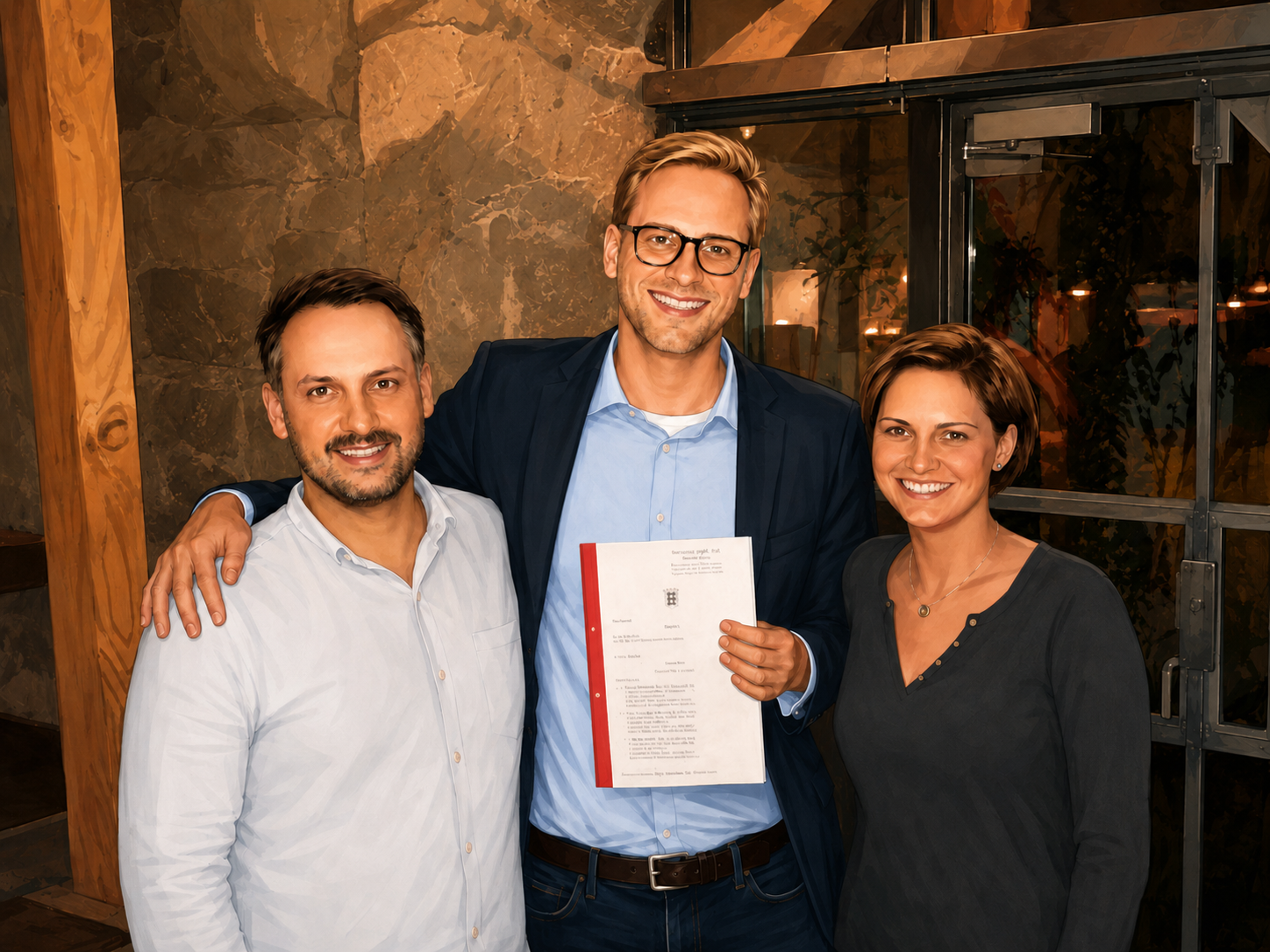 In 2019, Dr. Ralf Amann founded the Tübingen-based start-up Prime Vector Technologies (PVT) together with Dr. Ferdinand Salomon and Dr. Melanie Müller (from left to right). © Prime Vector Technologies
The technology has therefore proven its worth – but might there be more suitable candidates than adenoviruses? For immunologist Dr. Ralf Amann, the answer is a definite yes: ORFV. He has been working with the virus since his doctoral research, initially at the Friedrich-Loeffler-Institut (Greifswald) and later at the Institute of Immunology at Tübingen University Hospital. "We developed our first vaccine concepts quite early on. Even though they were still relatively simple, we saw great potential right from the start and were determined to further develop the technology for use in humans. It was while working at the hospital that the idea arose to use it for cancer treatment as well."
Amann applied for funding, secured Boehringer Ingelheim as an industry partner and received support from the Biotechnology Start-up Initiative (GO-Bio). Basic research led to a product idea, and he set up a small research team. An EXIST research transfer grant in 2018 marked the next crucial step; in 2019, he founded the start-up Prime Vector Technologies (PVT) in Tübingen together with Dr. Melanie Müller and Dr. Ferdinand Salomon. "There was already considerable interest from the industry; the next step would only be made possible by setting up a company," says Amann.
The product concept: an Orf virus rendered harmless to humans and animals, which serves as a vector to deliver foreign DNA specifically into cells, enabling the development of vaccines and cancer immunotherapies. ORFV is particularly well suited to this task because, as a poxvirus, it has a large linear double-stranded DNA genome and thus more than twice the 'cargo capacity' of adenoviruses. It can accommodate up to five antigens or a combination of antigens and immunostimulants, such as cytokine genes, making it possible to precisely control – or 'orchestrate' – the immune response. "We can, so to speak, teach the immune system how to respond to the antigen," says Amann. The reason this works lies in the way viruses interact with the immune system: a strong immune response requires two signals, consisting of a foreign antigen and a danger signal. Viruses provide precisely this combination. They simultaneously deliver the antigen into cells and trigger an alarm signal, thereby activating both the innate and adaptive immune systems. The platform is highly versatile: it can be used for prophylactic vaccines against infectious diseases, therapeutic vaccines and even oncolytic cancer immunotherapies.
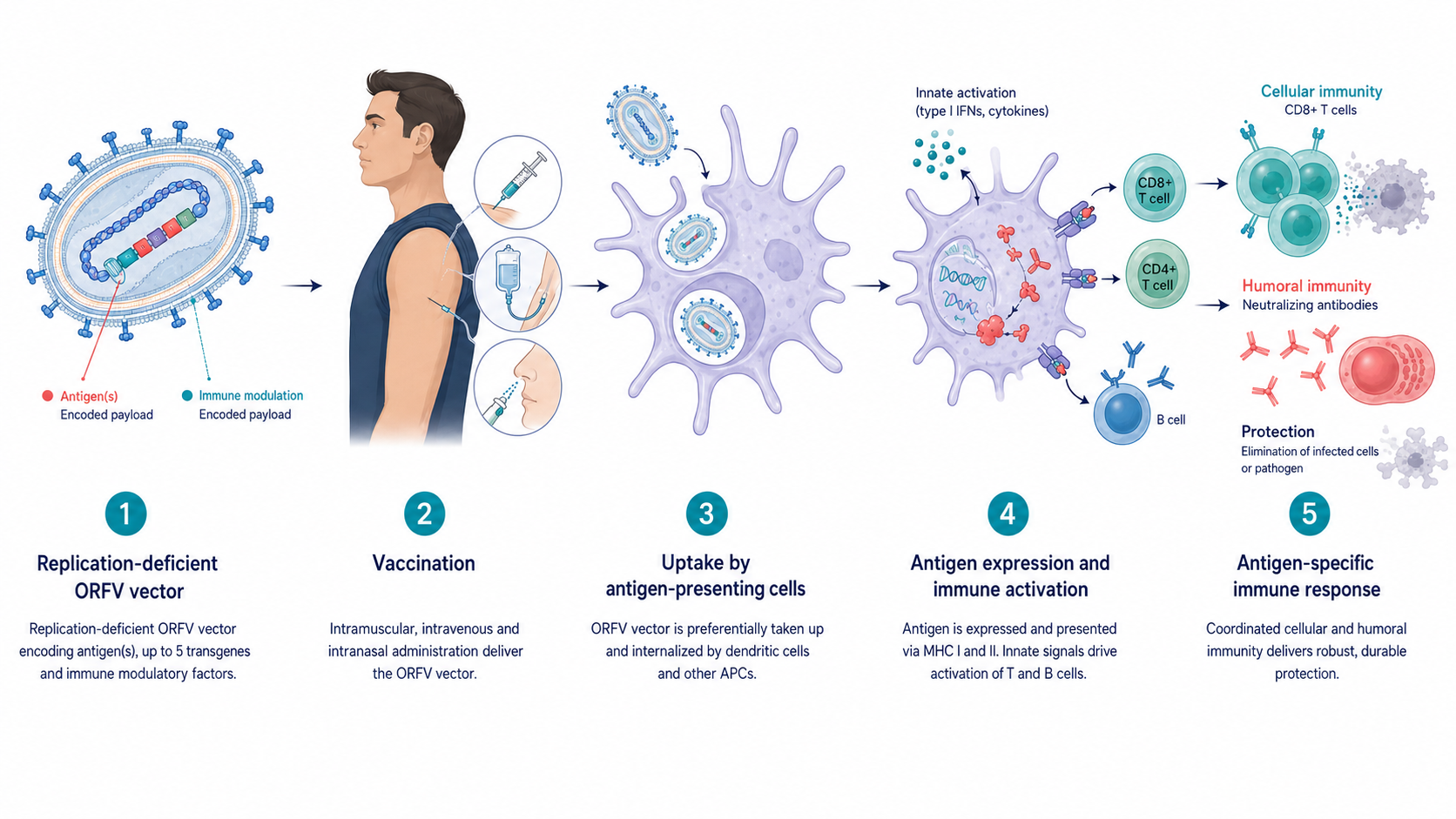 How the Orf platform works: antigen(s) and immunostimulants are integrated into the replication-deficient viral vector using recombinant technology and administered via vaccination. The cells take up and express the antigen, thereby specifically activating the immune system. © Prime Vector Technologies
There are also practical advantages: ORFV is genetically stable and shows a high degree of thermal stability. "Even at 25 °C, the vaccine remains stable for a month. At 37 °C, it remains stable for just under a week. This makes it suitable for distribution in hard-to-reach or warmer regions," the immunologist explains. "But one of the key advantages is something that has so far been one of the major limitations of viral vectors in vaccines: the immunogenicity of the vector itself. This can result in the vector being recognised and neutralised by the immune system before it can produce the desired vaccine effect. In contrast, with our Orf platform, we see no negative effect from antibodies against the vector. This means that our technology can be used repeatedly – for example, to specifically enhance the immune response through booster vaccinations or to develop different vaccines based on the same platform."
Speciality: respiratory pathogens
PVT started out with a vaccine candidate against COVID-19. With Prime-2-CoV, the company developed the world’s first ORFV-based vaccine to enter clinical trials in humans. Although the Phase I trial was successful and a Phase I/IIa trial is now underway, the project will not be pursued commercially. "There is no longer a market for COVID vaccines. Our main aim was to gather data on safety, optimal dosage and the immune response," explains Amann.
PVT also has a universal influenza vaccine in the pipeline, which is being developed in collaboration with Tübingen University Hospital. The aim is not only to protect against seasonal influenza but, ideally, to provide protection lasting several years. Preclinical development is expected to be completed by the end of 2027, after which a larger investment will be required to proceed to clinical trials. "We can still manage the development ourselves up to Phase I or II. After that, we would either seek a partner for the project or sell it," says Amann.
 The Orf vector delivers the genetic information encoding the antigen into the target cells, where it is expressed and the antigen is presented to the immune system. This triggers an immune response and also leads to the formation of long-term immunological memory. © Prime Vector Technologies
Another project, conducted in collaboration with the Fraunhofer Institute for Interfacial Engineering and Biotechnology (IGB) and the NMI Natural and Medical Sciences Institute at the University of Tübingen, is developing a vaccine against human metapneumovirus (hMPV). "Respiratory pathogens are one of our key areas of focus," says the founder. "We also have several vaccine candidates against pathogens with pandemic potential – such as Marburg, Ebola and Lassa viruses – in preclinical development. Here, too, commercial considerations are not our primary motivation. Vaccines are among the greatest medical achievements of all time and have contributed enormously to human well-being. For me, they are therefore not only fascinating from an immunological perspective, but also represent a responsibility to society. It is important to be prepared in the event of an emergency." Developing new candidates has long since become routine: "Engineering new viral vaccines now works like a well-established modular system for us," he says. "We have hundreds of candidates ready to go. The real challenge only begins afterwards, with time-consuming and costly preclinical and clinical trials."
Licence for cancer immunotherapy
The situation is even clearer when it comes to cancer immunotherapies: in July 2026, PVT entered into an exclusive licence agreement with Boehringer Ingelheim for the global use of ORFV technology. The aim is to develop a new generation of cancer vaccines to be used both as stand-alone therapy and in combination with other anti-cancer drugs from Boehringer Ingelheim. Further development now lies entirely with Boehringer because, as Amann says: "This field offers so many potential applications that a small biotech company like PVT could not fully exploit them on its own. Oncology in particular is expensive, complex and requires very powerful technology, as well as other elements such as suitable antigens and effective co-treatments – checkpoint inhibitors or other immunomodulators. That alone makes development very costly. However, if the project is successful, we will receive milestone payments."
PVT is now about to restructure. "We want to minimise risk but we also we want to give the next generation a chance. We have a great team with strong technological expertise. Our hope is that they will carry the work forward and fully realise the potential of the technology," says Amann. Six months ago, he moved to Fraunhofer IGB, where he heads the Virus-Based Therapies and Technologies division, and has since largely stepped back from PVT’s day-to-day operations. Following the agreement with Boehringer, he no longer needs to be so closely involved: "The company is now well established." However, he will remain with the start-up as a board member.
