Cancer prevention with a single jab
Therapeutic vaccine against HPV-induced tumours
Persistent infections with human papillomaviruses (HPV) are the primary cause of cervical cancer. Researchers from Heidelberg have developed a promising therapeutic vaccine consisting of immunogenic virus peptides linked to silica nanoparticles, which is currently being investigated in preclinical studies. The vaccine activates specific cytotoxic T cells and is usable regardless of HLA type.
Cancer is classically considered a non-communicable disease, although a significant proportion of tumours can be traced back to infectious viral or bacterial agents. "Human papillomaviruses, in particular, play a central role in the development of cancer in mucosal linings," explains Assistant Professor Dr. Dr. Angelika Riemer from the German Cancer Research Center (DKFZ) in Heidelberg. Riemer, who heads up the Department of Immunotherapy and Immunoprevention, is working intensively on the development of a therapeutic HPV vaccine.
HPV infection is not treatable
 The research group led by PD Dr. Dr. Angelika Riemer (front centre) is developing a therapeutic HPV vaccine that specifically activates cytotoxic T cells and aims to support the immune system in combating persistent infections and early-stage tumours. © DKFZ
HPVs constitute a group of over 200 different DNA viruses that primarily infect the epithelial cells of the skin and mucous membranes. The majority of sexually active individuals become infected at some point in their lives; in about 90 percent of cases, the immune system successfully eliminates the virus. However, if the infection persists for months or years, it can trigger uncontrolled cell growth in the affected tissue. Typically, benign growths such as genital warts develop. However, in cases involving high-risk types, malignant changes in the cells are possible. Nearly every cervical cancer is caused by HPV, but tumours of the vulva, penis or anus, as well as in the mucous membranes of the oral cavity and throat, are also attributed to the infection. Worldwide, the virus accounts for four to seven percent of new cancer cases annually, with three-quarters being cervical cancers.1) 2)
The Standing Committee on Vaccination (STIKO) in Germany therefore recommends HPV vaccination for all 9- to 14-year-olds before their first sexual contact. Although the vaccine reliably prevents infections with the two oncogenic high-risk types HPV16 and HPV18, as well as seven other types, only 55 percent of girls and 34 percent of boys were vaccinated in Germany by the end of 2024.3) Vaccination rates worldwide are significantly lower than in Germany and the vaccine has no therapeutic effect. As surgical removal is currently the only treatment option for persistent infections or tissue growths, alternative treatment approaches are urgently required.
MHC-bound peptides as a target for therapeutic vaccination
A central event in tumour development is the integration of viral DNA into the host cell's genome. This increases the amount of viral proteins E6 and E7, which can – in the case of high-risk types – cause cancer-triggering changes in cells.4) "Cell growth is driven here by viral oncoproteins and not, as in most other tumours, by mutated endogenous proteins," Riemer clarifies. "This opens up the possibility of eliciting a specific immune response through cytotoxic T cells directed exclusively against HPV-infected cells."
Cytotoxic T lymphocytes are specialised cells of the immune system that are classified as so-called killer cells. In contrast to B lymphocytes, which produce antibodies against the respective pathogen following vaccination and thus prevent infection, this subset of T lymphocytes attacks already infected or altered body cells.
Immunopeptidomics is the analysis of peptides presented by HLA class I and HLA class II molecules on the cell surface. After the tissue to be analysed has been processed, the HLA molecules are isolated and the peptides are extracted and identified using mass spectrometry. Depending on the objective, either the full repertoire of peptides can be characterised or specific fragments of a particular protein can be selectively targeted. In this way, so-called neo-peptides, which are presented on mutated tumour cells and represent target structures for cancer immunotherapies, can also be identified.
Almost all mammalian cells carry so-called MHC (major histocompatibility complex) class I molecules on their surface, to which short fragments of intracellularly synthesised proteins are bound. Through the presentation of these peptides, the immune system gains insight into the processes occurring within the cell. When foreign or altered peptides appear on these molecules, T lymphocytes recognise these so-called epitopes via their T-cell receptor and eliminate the affected cell. Since HPV-infected cells present peptides of the viral proteins E6 and E7, the activation of specific T cells through therapeutic vaccination is considered a promising approach in the fight against the tumour.
"Despite decades of research, this has not yet been achieved," says Riemer, who is also affiliated with the German Center for Infection Research. "One possible reason is that most approaches have used the full-length E6 and E7 proteins of the HPV16 virus. This carries the risk that the immune system mounts a response against an epitope that is not actually present on the target cell. Therefore, we specifically analysed the peptides presented by cancer cells."5)
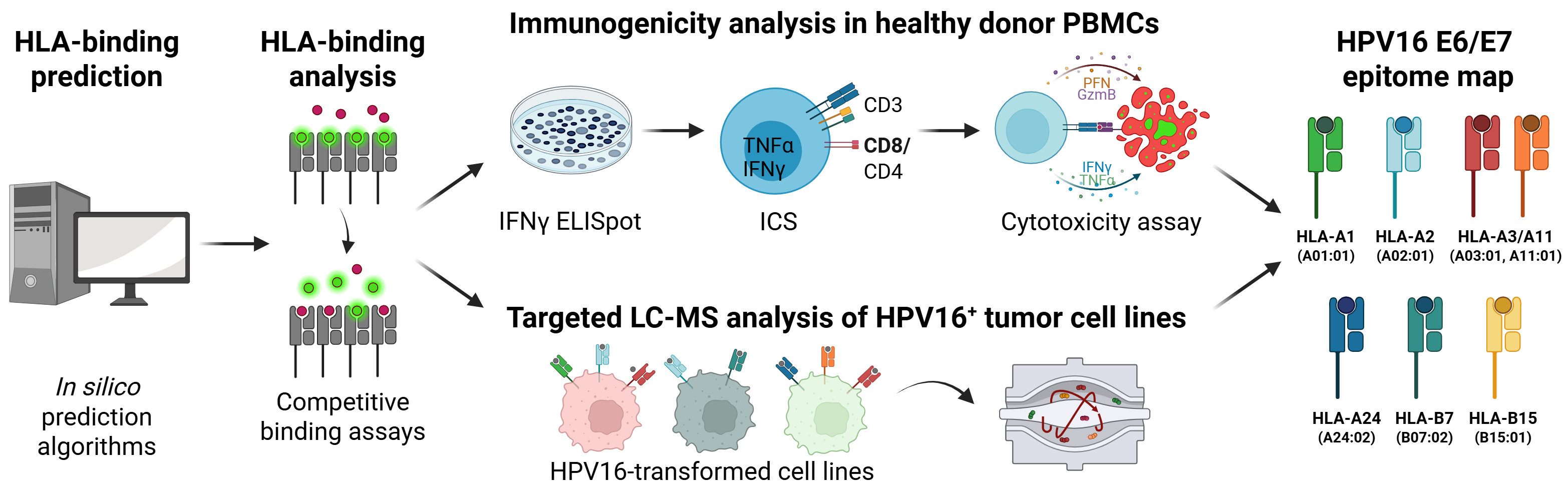 Based on the sequence of the oncoproteins E6 and E7, potential HLA-binding peptides were predicted and tested in binding assays. The immunogenicity and cytotoxic potential of positive candidates were subsequently investigated in cell culture. In parallel, a targeted analysis of the peptides presented on HPV16+ tumour cells was performed using mass spectrometry. Based on the data obtained, immunogenic peptides were identified for six different HLA class I molecules that are suitable for use in a therapeutic vaccine. A vaccine comprising peptides covering all six HLA types would be applicable to more than 99% of the global population. © Created in BioRender. Riemer, A. & Wellach, K. (2026) https://biorender.com/9tkhv1d
Using in vitro binding assays, the researchers initially determined which fragments of E6 and E7 are capable of binding to human MHC class I molecules referred to as HLA (human leucocyte antigen). They then investigated in cell culture whether these peptides can activate cytotoxic T lymphocytes, enabling the elimination of cells presenting the corresponding peptide-HLA complexes. In parallel, the team refined immunopeptidomics and established a highly sensitive workflow to specifically identify HPV-derived peptides on the surface of cancer cells using mass spectrometry.
Each individual possesses a unique set of three highly variable HLA-I molecules (A, B and C), which can, however, be grouped into HLA supertypes based on their peptide-binding properties. The extensive analyses were therefore conducted for six supertypes, together covering 99 percent of the global population. A first important finding, according to the immunologist, is that some HPV-derived peptides that are presented at early stages are no longer detectable in established tumours. This information may help in the targeted development of a vaccine against persistent infections and precancerous lesions. At this stage, the immune system is still able to effectively eliminate infected cells.
Nanoparticles as transport medium
The vaccine is based on 20 – 50 nm silica beads developed by a start-up company called Silvacx. Together, the partners developed a biocompatible surface coating as well as an adsorptive peptide-binding strategy. To enhance the immune response, the adjuvant poly(I:C) was also conjugated to the nanoparticles. In their paper published in December 2025, the researchers demonstrate that vaccination with an HLA-A2-specific HPV peptide induces activation of cytotoxic T cells in MHC-humanised mice and achieves cure rates of more than 50 percent in subcutaneous HPC tumours.6)
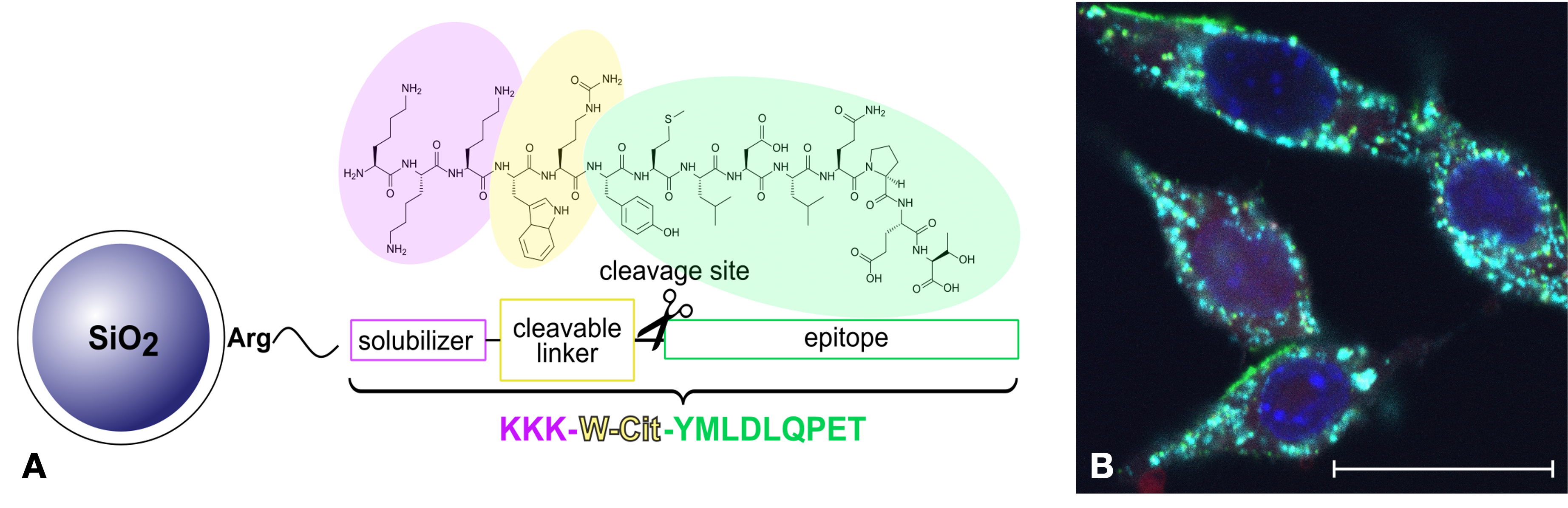 A: Structure of the silica nanoparticle construct used for vaccination: the immunogenic peptide YMLDLQPET derived from the HPV16 E7 oncoprotein is conjugated to the silica beads via a cleavable linker sequence and a solubility-enhancing fragment. B: Fluorescence microscopy image of murine antigen-presenting cells that have taken up epitope-bearing silica nanoparticles (cyan/green) following vaccination (blue: nucleus). Scale bar = 20 µm. Source: A: Schematic representation of the SiNP construct, Kruse S. et al., https://doi.org/10.1080/2162402X.2025.2548002, CC-BY-NC 4.0 (https://creativecommons.org/licenses/by-nc/4.0/) I B: SiNP-epitope uptake by APCs, Kruse S. et al., https://doi.org/10.1080/2162402X.2025.2548002, CC-BY-NC 4.0 (https://creativecommons.org/licenses/by-nc/4.0/)
Preclinical studies are currently underway with a vaccine containing six different peptides that correspond to the six HLA supertypes. HPV-dependent tumour cells were injected into the mucosal tissues of the genital tract and the base of the tongue in MHC-humanised mice to investigate the vaccine’s effect at relevant locations. "We are very optimistic that the vaccination will be effective and that we will soon be able to conduct clinical trials," says Riemer.
Silica nanoparticles as a vaccine platform offer several advantages: they protect their cargo from degradation in the body, and, due to their small size, enable efficient transport to the lymph nodes. Once there, they are taken up by antigen-presenting cells that present the epitopes bound to HLA molecules on their surface and activate specific T cells. The vaccines are easy to produce and very stable, making them well suited for global use.
