Robotics in medicine: initial trials of HASEL technology
Using artificial muscles to reduce uncontrolled tremors
For people with tremors, even simple everyday tasks can become a challenge. Researchers from Stuttgart and Tübingen are developing a novel assistive system designed to actively suppress these involuntary movements. Initial tests using artificial muscles based on HASEL technology have shown promising results – but there is still a long way to go before the technology is ready for everyday use.
Uncontrolled muscle movements are a common symptom of neurological disorders such as Parkinson’s disease and multiple sclerosis. They primarily affect the limbs and can have a significant impact on the lives of those affected. "Tremor is often the most debilitating symptom of the disease," explains Prof. Dr. Daniel Häufle, head of the Neuromechanics and Rehabilitation Robotics Research Group at the University of Tübingen. The group is affiliated with the Hertie Institute for Clinical Brain Research and the interfaculty Werner Reichardt Centre for Integrative Neurosciences (CIN). It focuses on both basic research and translating scientific findings into practical applications.
Muscle-like soft robots designed to suppress tremors
The impaired fine motor control caused by tremor can make even simple tasks such as holding a cup or using a pen difficult. Medication can effectively alleviate symptoms, particularly in the early stages of the condition, but must be tailored to the individual and is often associated with side effects. When medication becomes less effective, deep brain stimulation may be an option in some cases. This involves implanting electrodes that selectively modulate pathologically altered neuronal activity.1) However, currently only a few everyday technical aids, such as self-stabilising cutlery or orthoses with mechanical damping systems, are available to complement medical treatment.
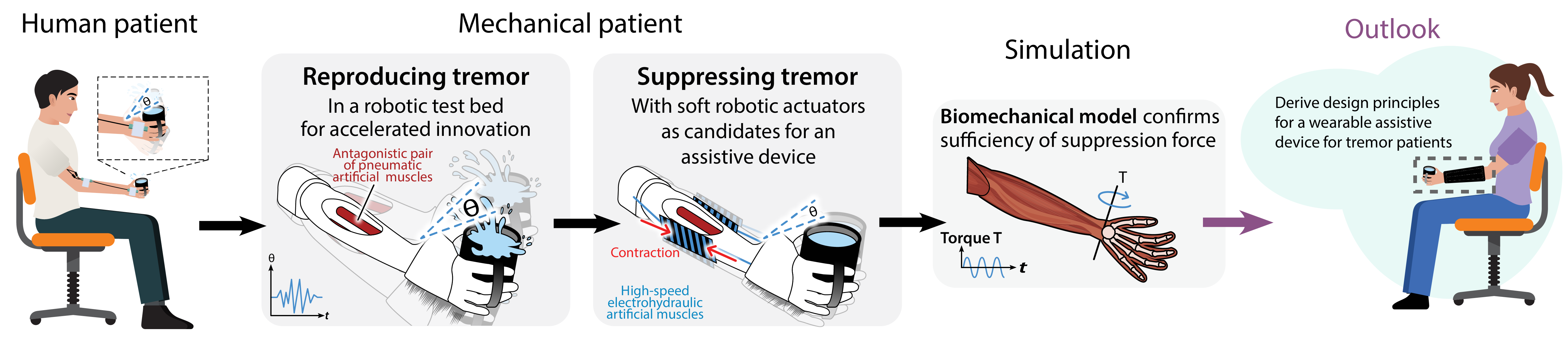 singleimage.big_view Schematic representation of the workflow for developing a wearable assistive device.
Based on real patient data, the researchers use their robotic forearm to simulate typical tremor movements and suppress them with the aid of a pair of antagonistic artificial HASEL muscles. A biomechanical simulation model establishes the forces required for this purpose. The aim is to develop a lightweight, quiet and portable assistive device.
Source: "Comprehensive approach for a rapid evaluation of emerging tremor-suppression technologies", A. Shagan Shomron, CC-BY-NC https://creativecommons.org/licenses/by-nc/4.0/, https://doi.org/10.1016/j.device.2025.100719
As part of the ‘Artificial Muscles for Tremor Suppression’ project, based at the Interdisciplinary Centre for Bionic Intelligence Tübingen Stuttgart (BITS), researchers are developing a robotic assistance system designed to actively counteract tremors as they occur. BITS, founded in 2025, is a joint initiative between the two universities and the Max Planck Institutes for Intelligent Systems (MPI-IS) and Biological Cybernetics. Its goal is to develop intelligent bionic systems for diagnosing and treating neurological and psychiatric disorders. The research consortium is part of Cyber Valley, Europe’s largest and leading centre for artificial intelligence and modern robotics.
This ambitious project is a collaboration between Häufle and Prof. Dr. Christoph Keplinger, Head of the Robotics Materials Department at MPI-IS and Prof. Dr. Syn Schmitt, Head of the Institute for Modelling and Simulation of Biomechanical Systems (IMSB) at the University of Stuttgart. At its core is the HASEL technology developed by Keplinger, which uses artificial muscles for soft robotics that combine electrostatic and hydraulic forces. Unlike conventional actuators, which contain rigid, expensive and often noisy components, HASEL actuators are made from deformable, comparatively inexpensive materials and operate very quietly. Their design – a soft plastic pouch filled with a special non-conductive oil and fitted with flexible electrodes on its outer surface – enables them to actively contract. This makes the technology particularly suitable for biomimetic applications that seek to replicate muscle-like movements.
Infobox: HASEL
HASEL (hydraulically amplified self-healing electrostatic) actuators consist of flexible plastic pouches filled with non-conductive oil and partially covered with electrodes on the outside. When an electrical voltage is applied, the electrodes are attracted to one another, displacing the fluid between them into the rest of the pouch. This causes the pouch to bulge in one area and contract lengthways (Fig. 2).
Several HASEL elements can be arranged in series or stacked on top of one another to generate different forces and degrees of contraction. Depending on their configuration, they can produce different types of movement. The technology forms the basis for a new generation of soft robots. The deformable and adaptable materials enable gentle, quiet and fluid movements that mimic the way human muscles function.
HASEL actuators pass the test
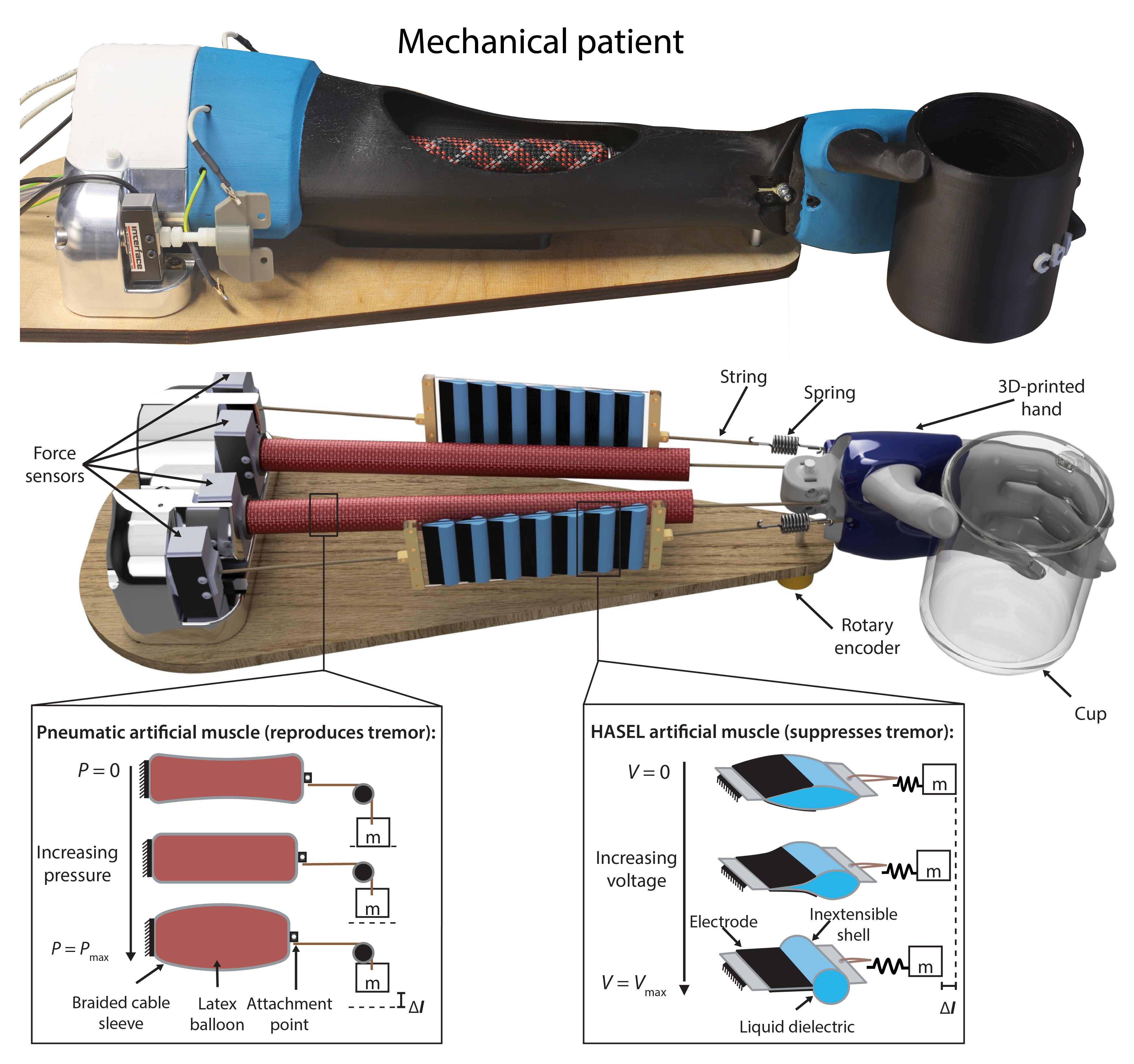 The mechanical patient generates the tremor using a pair of counter-acting pneumatic muscles. The HASEL actuators, which are mounted on the outside, contract as the electrical voltage increases, thereby counteracting the tremor. Source: "Design and control of the mechanical patient and tremor-suppression mechanism", A. Shagan Shomron, CC-BY-NC https://creativecommons.org/licenses/by-nc/4.0/, https://doi.org/10.1016/j.device.2025.100719
At the start of the project, the team needed to determine whether HASELs were fast and powerful enough to effectively suppress a typical human tremor. As the existing prototypes did not meet the safety requirements for clinical trials involving humans, they first developed a robotic forearm with a hand capable of realistically simulating a human tremor. "This mechanical patient operates using a pair of counter-rotating pneumatic muscles," explains Dr. Alona Shagan Shomron from Keplinger’s research group. "Based on real patient data, these generate the characteristic frequency ranges and amplitude fluctuations of the tremor movement in the wrist."
In a paper published in 2025, the researchers demonstrated that two HASEL actuators acting as an antagonistic pair and attached to the side of the mechanical arm successfully suppressed tremors.2) "With the help of our novel artificial muscles, we can, for example, prevent liquid from spilling out of a cup held in the hand," says the lead author, describing the experimental setup. "All it takes is HASEL actuators around 1 mm thick and weighing around 15 g, which contract or relax in a targeted manner in response to the tremor movements."
Biomimetic robotic arm as an open-access test system
The researchers have deliberately chosen not to patent this promising concept and are making their findings freely available. In so doing, they aim to support international research and accelerate further development of the technology. The entire research community can use the mechanical patient to test new exoskeleton technologies. Combined with biomechanical computer simulations, the system enables researchers to assess the performance of different technologies quickly and at an early stage of development – without the need for time-consuming and costly human trials. Moreover, the robotic forearm can simulate different types of tremor.
Great potential, many challenges
 The research team (from left to right): Dr. Alona Shagan Shomron, Prof. Dr. Syn Schmitt, Prof. Dr. Christoph Keplinger and Prof. Dr. Daniel Häufle. © MPI for Intelligent Systems, W. Scheible
"We want to develop a wearable assistive device that is so light and thin that users can wear it discreetly under their clothes," says Shagan Shomron, outlining the research team’s vision. As HASEL technology operates very quietly, it is ideally suited for everyday use. However, there is still a long way to go before this vision becomes a reality. Shomron, a materials scientist, explains: "First, we need to miniaturise the electronic components, then insulate them and develop a casing."
Häufle points to another challenge: "At the moment, we measure the angle of the hand relative to the forearm and stabilise the wrist in a neutral position. However, the joint usually moves during almost every activity, and the sensors still interpret these movements as tremors. At BITS, we are therefore working on recognising and integrating user intent so that, for example, brushing one’s teeth is not mistaken for a tremor. Our device must learn to understand the context of the movement."
Although the work is still in its early stages, the considerable potential of HASEL technology is already clear. HASEL-based soft exoskeletons are relatively easy to manufacture, respond to tremors within milliseconds, are readily scalable and energy-efficient, and have the potential to minimise unwanted effects on the user. In 2025, the team received the Parkinson’s Tremor Research Prize from the Parkinson Stiftung3) for its innovative approach and is also supported by the Claudine und Eike Hallwachs Stiftung.4)
The project combines expertise from the Stuttgart and Tübingen sites in robotics, embodied AI and machine learning with expertise in medical research and neuroscience. It thus exemplifies the BITS approach: close interaction between intelligent technological systems and humans, with the aim of improving people’s quality of life.
