Use of health data
The digital twin – shaping the future of neonatal medicine
Virtually every newborn undergoes routine screening shortly after birth to detect congenital disorders. Over the decades, these examinations have generated a unique wealth of data on early childhood development. However, for many years this valuable resource remained largely untapped. That all changed when researchers in Heidelberg started to use the data to develop a digital twin for newborns. Today, the technology is on the verge of entering clinical practice.
Few medical screening programmes achieve such comprehensive insurance coverage. Since 2005, the expanded newborn screening (NBS) programme has been covered by statutory health insurance, and almost every baby in Germany undergoes screening between 36 and 72 hours after birth. During this voluntary test, a few drops of blood are collected and analysed for up to 20 rare congenital disorders, many of which can be effectively treated if detected early. Newborn screening is complemented by the regular paediatric preventive examinations (known in Germany as U-check-ups), which includes six scheduled appointments the first year of life alone. Together, these programmes rank among the most successful preventive healthcare measures in Germany.
Although newborn screening is performed in maternity hospitals and specialised laboratories across Germany, the scientific concepts underpinning the programme were developed at a small handful of centres. Heidelberg is one. Here, paediatrician and metabolic disease specialist Prof. Dr. Georg Friedrich Hoffmann has played a pivotal role in shaping the expanded newborn screening programme from its inception. Over the decades, the Centre for Paediatrics and Adolescent Medicine at Heidelberg University Hospital has built one of Germany's most comprehensive newborn screening databases - a unique resource containing many millions of anonymised measurements.
The digital twin for newborns: earlier detection, better prevention
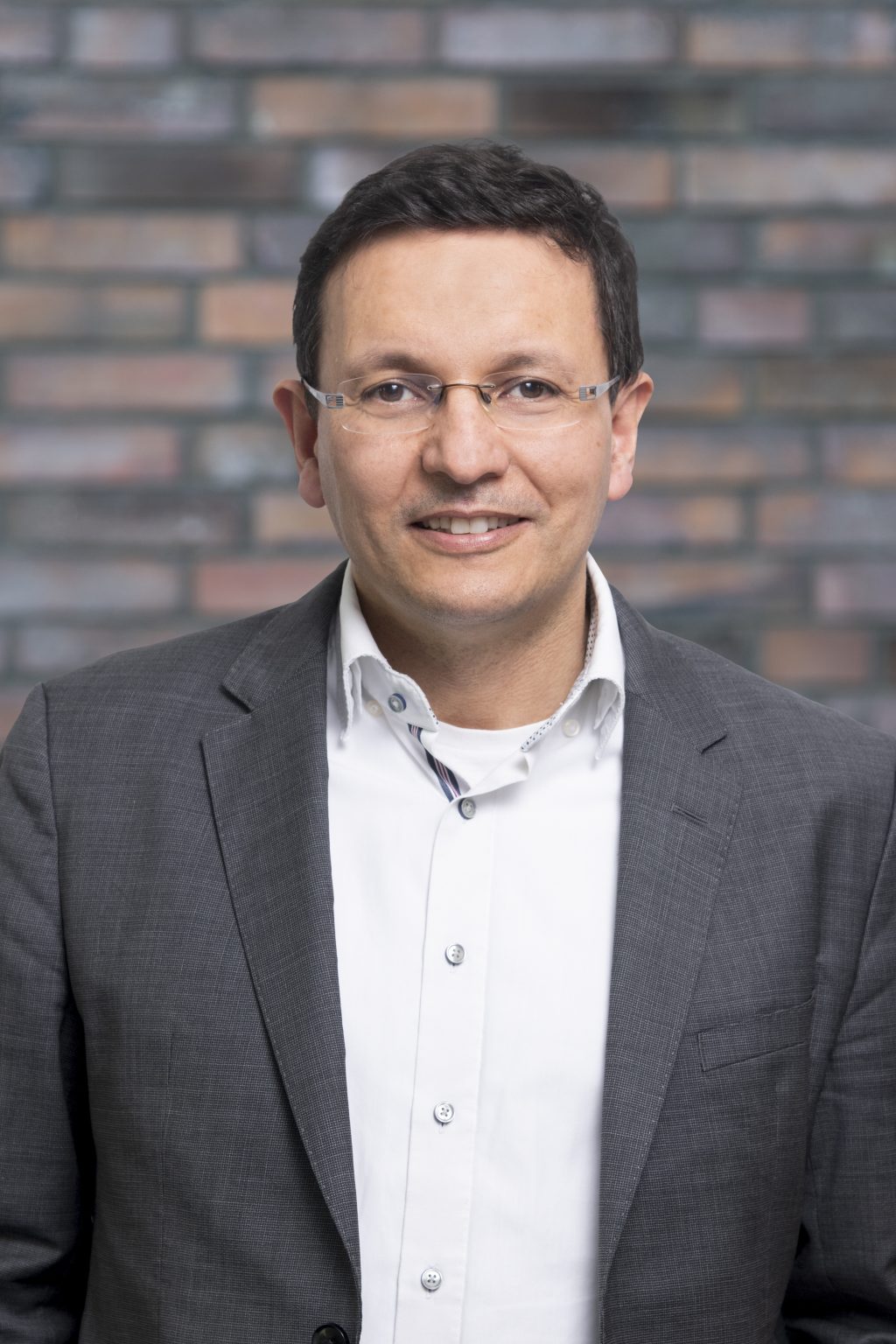 Prof. Dr. Vincent Heuveline managing director of the Computing Centre and chief information officer (CIO) at Heidelberg University. He also heads two research units: the Engineering Mathematics and Computing Lab (EMCL) at the Interdisciplinary Centre for Scientific Computing (IWR) and the Data Mining and Uncertainty Quantification research group at the Heidelberg Institute for Theoretical Studies (HITS gGmbH). © HITS gGmbH
"What should we do with all the information that is incidentally generated during newborn screening? How can we combine data and clinical experience to uncover patterns that would otherwise remain hidden? And could artificial intelligence succeed where the human brain can go no further?" These were the kind of questions Prof. Dr. Georg Friedrich Hoffmann began asking many years ago. In his search for answers, he turned to his colleague Prof. Dr. Vincent Heuveline. A computer scientist and mathematician, Heuveline is the managing director of the Computing Centre and chief information officer (CIO) at Heidelberg University. He also heads the Engineering Mathematics and Computing Lab (EMCL) at the Interdisciplinary Centre for Scientific Computing (IWR) and the Data Mining and Uncertainty Quantification research group at the Heidelberg Institute for Theoretical Studies (HITS). One of the key challenges the two researchers discussed was the rarity of positive findings. Among the millions of measurements generated by newborn screening, only a tiny fraction indicate a congenital disorder. Identifying these few affected newborns reliably without producing false-positive results is therefore an exceptional challenge. "False-positive findings should be avoided wherever possible because they cause enormous anxiety for families. We therefore have to achieve the highest possible level of reliability," the researchers agree.
The idea quickly evolved into a collaborative research project. Together with an international team from Heidelberg University, the Heidelberg Institute for Theoretical Studies (HITS) and the University of Galway in Ireland, Heuveline set out to unlock the potential of the screening data. The researchers used millions of measurements from newborn screening and routine paediatric examinations (U-check-ups) during the first 18 months of life to develop personalised digital twins - computational models of infant metabolism designed to predict disease risks, estimate treatment responses and support clinical decision-making. The project marked a major breakthrough. For the first time, researchers successfully simulated an infant's metabolic development using personalised mathematical models. The whole-body models incorporated 26 organs, six cell types and more than 80,000 metabolic reactions and were individually calibrated using real-world data from newborns1) "We are proud to say that this project has enabled us to uncover meaningful relationships hidden within medical data that had previously remained largely unused," says Heuveline. "Such comprehensive datasets provide an exceptionally robust and reliable foundation and are invaluable for artificial intelligence and numerical simulations."
When hypotheses become evidence
How were the data transformed into infant models? Three fundamentally different approaches were used. The first was a model-based approach in which metabolic pathways were mapped mathematically. These pathways were initially identified by the team’s biologists and subsequently translated into mathematical models. "One of the biggest challenges at the outset was that some metabolic pathways had not yet been fully characterisedd, while others had not yet been characterised at all," explains Heuveline. "For mathematicians, however, a model must be complete and mathematically solvable. Only then can it be solved reliably and used for meaningful simulations. Filling these gaps in biological knowledge was therefore a crucial step in developing the digital twins."
In the end, all the hard work paid off. The researchers were able to investigate in silico how different parameters influence infant development. "In doing so, we uncovered a large number of correlations," says Heuveline. "As mathematicians, they were initially just numbers to us. But when we discussed the findings with the medical experts, there were several real 'aha' moments: hypotheses suddenly became tangible." This sparked intensive discussion between the disciplines, during which the models were continuously tested and refined. "In a way, mathematics helped us better understand the real world," he explains. "Time and again, we found that what experienced clinicians had long suspected could suddenly be supported by quantitative evidence."
AI passes the aptitude test
 The digital twin for newborns was developed by processing an extensive dataset from the newborn screening programme, which enabled researchers to simulate the health-related development of the infants across their entire metabolic network. © AI-generated | HITS gGmbH
A second approach focused on harnessing artificial intelligence to analyse the enormous volume of data. The researchers developed and trained AI models that linked biochemical measurements with clinical findings. One particular challenge was the highly imbalanced dataset. "There is an abundance of data from healthy babies – fortunately, but comparatively little from babies with medical conditions," explains Heuveline. "The system therefore had to learn how to deal with this imbalance." The researchers ultimately succeeded. In order to validate the system, they first trained the AI models using only a subset of the available data. The remaining data were then used to assess the accuracy of the system’s predictions. They used the remaining data to test the accuracy of the system’s predictions. And indeed, cases with previously documented pathological findings were reliably identified, demonstrating the system’s ability to recognise infants requiring immediate medical attention.
However, the professor points out that the system’s Achilles heel remains its 'black box' nature. "What we need now is explainability – that’s what we’re currently working on," he says. Only once the AI’s decision-making process is transparent can the system be certified and introduced into routine clinical practice. The vision is that, shortly after newborn screening, physicians will receive a notification on their tablet – for example, 'no cause for concern' or 'further investigation required'. "But the result alone is not enough," Heuveline emphasises. "The AI must also provide a clear and comprehensible explanation of how it arrived at its assessment. Otherwise, it cannot be used in clinical practice."
Prototype ready for the next step
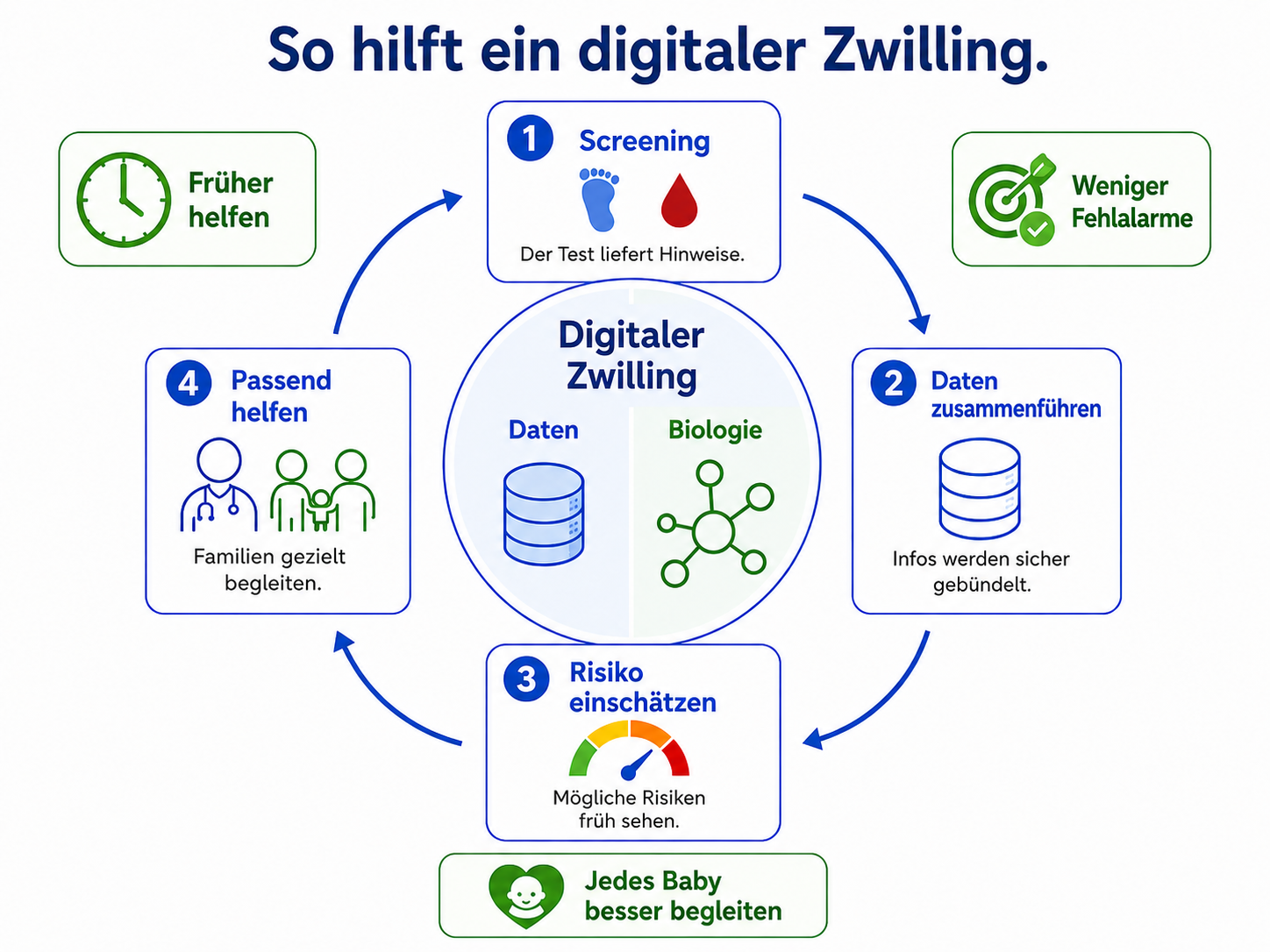 This is how the digital twin is expected to work in clinical practice in the future: it is designed to reduce false-positive results, assess risks at an early stage and, where necessary, enable treatment to begin promptly. © AI-generated | HITS gGmbH
The third step in the research project was to combine the two approaches. The result was a system that brings together the strengths of both worlds: mathematical modelling and AI. The researchers now aim to extend the system to cover a much broader spectrum of diseases and clinical findings, while also incorporating the temporal dimension. So far, the models have focused on identifying risks immediately after birth. In future, this time window is set to be extended. This presents another challenge, however: babies develop rapidly, and their biological signalling pathways change accordingly. The models must therefore learn to capture these dynamic processes over time. But this also significantly increases their complexity. "We’re reaching the limits of what our computers can handle – the computational demands are simply exploding," says Heuveline. "This will require a user-friendly cloud-based system rather than an app running on a tablet."
For some medical applications, the digital twin has already reached the pre-production stage. The biggest challenge for practical implementation is therefore no longer the research itself, but certification and market launch. "The hurdles we face now are regulatory," says Heuveline. And this is where partners are needed: "We can develop and validate the prototypes, but turning them into a finished product requires expertise from other fields. If we manage to address the issues of explainability and regulation, the technology could make the leap into clinical practice relatively quickly." However, this final step is often a particular challenge for European research institutions. "We’re good at building prototypes, but unfortunately, that final step is often missing – it’s like running a marathon. Forty kilometres is a long way, but you still haven’t crossed the finish line." One thing is already clear, however: the Heidelberg researchers are likely to have made a decisive contribution to the development of a digital twin for newborns – and thus to the improvement of healthcare from the very start of life.
