Dossier
AI and robotics are shaping the future of medicine
Artificial intelligence and robotics are playing an increasingly important role in healthcare, as in many other areas of life. They offer considerable potential to improve medical care, but require an ethically responsible approach.
The healthcare sector currently accounts for around 12 percent of Germany’s gross value added, therefore making a significant contribution to the national economy (as of 2025).1) Around one in six people are employed in medical care, the healthcare industry or related sectors such as health insurance, administration and fitness centres. In Baden-Württemberg (BW), healthcare represents around 31 percent of the industrial sector, placing it as one of the state’s leading industries alongside automotive and mechanical engineering.
At present, however, the sector faces major challenges: demographic change is driving a steady increase in demand for healthcare services, while the shortage of skilled professionals continues to grow. Rising costs and administrative burdens place hospitals under increasing financial pressure, and regulatory requirements delay investment and innovation. Furthermore, digital technologies remain underutilised, and the sector still focuses too heavily on – often costly – treatment rather than prevention and early detection.
Supporting rather than replacing
Artificial intelligence and robotic systems are expected to play an increasingly important role in healthcare in order to ensure high-quality medical care over the long term. The aim is not to replace healthcare professionals, but to relieve their workload and support them in their daily work. This will free up more time and give more scope for uniquely human qualities such as empathy, creativity and responsible decision-making. At the same time, these technologies have the potential to make medicine more precise, efficient and patient-centred.
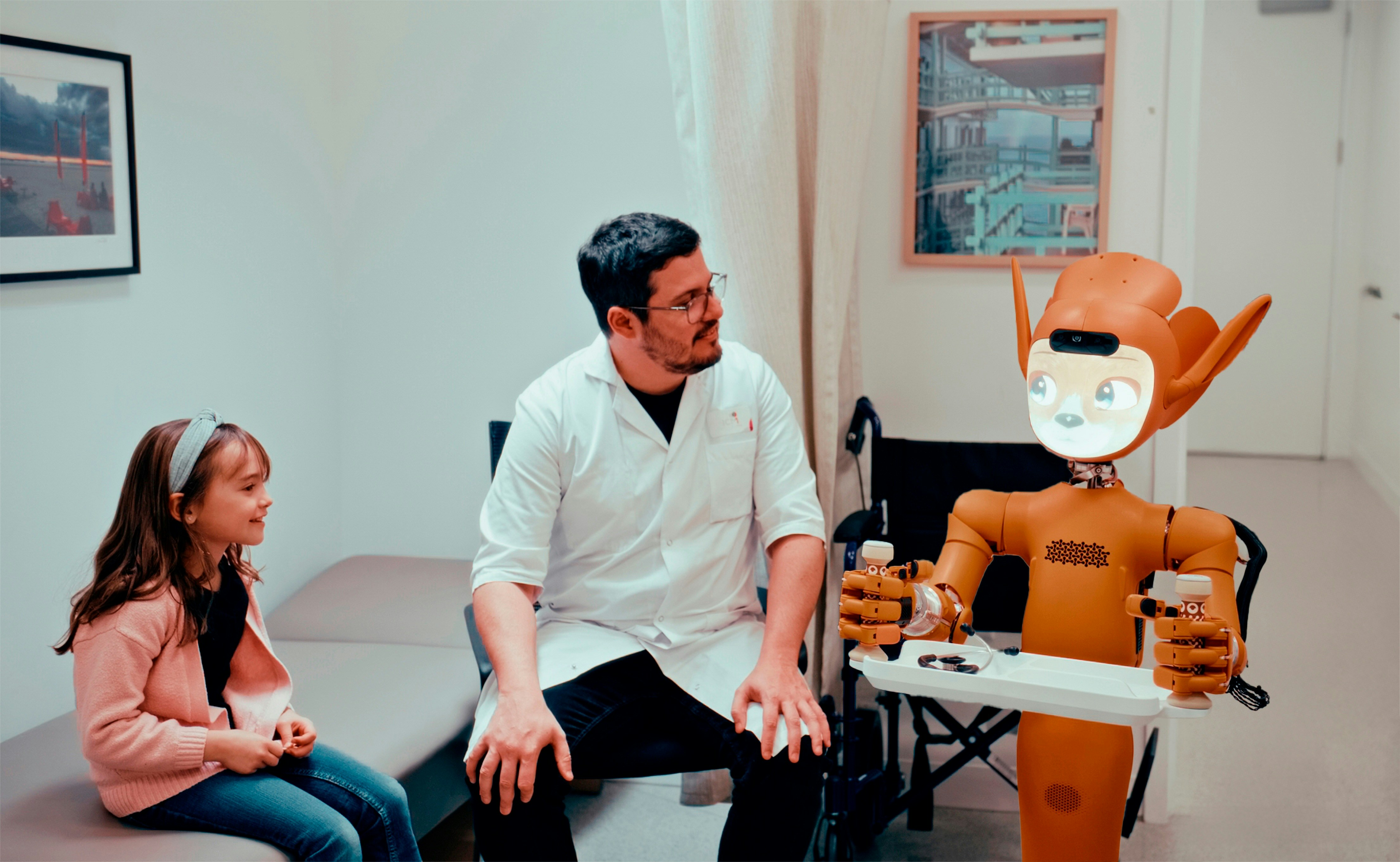 In the future, interactive robots could assist healthcare professionals in their work. © Enchanted Tools on Unsplash
Robots already alleviate the workload of healthcare staff by carrying out tasks that do not involve direct patient care, such as cleaning floors and transporting laundry, laboratory samples, medication and meals.²)³) In addition, humanoid robots that are able to provide assistance and perform simple care tasks are currently being trialled.⁴ )⁵) Meanwhile, the empathy robot Navel interacts with and entertains residents in care homes.⁶)
When it comes to surgery, the Da Vinci surgical system has been well established for several years.⁷) This robotic system is highly precisely controlled by surgeons via a console, and provides an enhanced view of the surgical field during minimally invasive procedures in the abdominal and thoracic cavities, compensating for physiological hand tremors and enabling hard-to-reach areas to be accessed.
Artificial intelligence (AI) and machine learning, in turn, are particularly valuable for analysing and interpreting medical data and images. For example, they can identify tumours in MRI and CT scans as well as in histological tissue samples, or analyse complex electroencephalograms (EEGs), all within a very short time.⁸)9)¹⁰) Wearable devices such as fitness trackers and smartwatches can continuously collect health data in everyday life, enabling early detection of conditions such as epileptic seizures.¹¹) In all these cases, however, the final decisions regarding diagnosis and treatment remain the responsibility of healthcare professionals. AI provides decision support, diagnostic suggestions and risk assessments, thereby facilitating faster and more accurate clinical decision-making.
In laboratory diagnostics, pharmaceutical manufacturing and quality control, AI and automation are making processes more efficient. These technologies can also accelerate drug development many times over.¹²)
Building trust through secure data use
 Artificial intelligence facilitates and improves the analysis of medical data, enabling more personalised treatment strategies. © Tung Lam from Pixabay
However, the interaction between humans and machines requires an appropriate technical and organisational framework and, above all, clear legal and ethical guidelines to prevent the misuse of sensitive health data. To this end, the healthcare sector, industry and academia must work together to build public trust in these new technologies. Only then can their full potential be realised for the benefit of patients.
AI systems, for example, are only as good as the data on which they are trained. The more patients make their health data available – including both positive and negative outcomes – the more accurate and reliable these AI-assisted systems become. Such personal health data are subject to particularly stringent protection under Article 9(1) of the General Data Protection Regulation (GDPR), and consent for their use as training data has so far been voluntary, purpose-specific and revocable at any time.¹³) However, the Health Data Use Act (Gesundheitsdatennutzungsgesetz), which entered into force in March 2024, established a legal basis that, under strict conditions, permits the use of anonymised and pseudonymised data for research projects without the explicit consent of the data subjects.¹⁴) The aim is to strengthen Germany's position as a leading location for medical research over the long term.
Medical AI systems, particularly those used for image analysis, require large amounts of high-quality training data. To address this challenge, MIRA Vision Microscopy GmbH has developed an innovative technology that generates suitable training datasets from synthetic photorealistic images within a very short time – entirely independently of patient data.15)
The challenge of digital health
A key prerequisite for the healthcare system of the future is comprehensive digitalisation of health data ranging from medical reports, laboratory results and medication plans to diagnostic imaging. The electronic patient record (ePA), which is being introduced in Germany from early 2025 onwards, therefore collects digital health information in a central repository. This is intended to facilitate communication between healthcare professionals, improve the quality of care, and help prevent unnecessary duplicate examinations and harmful drug interactions.
However, decentralised structures, incompatible interfaces and the still limited degree of data interoperability pose major challenges in Germany.¹⁶) Although large volumes of digital health data are already being collected, they are often stored in isolated systems – so-called data silos – and cannot be shared between healthcare providers or across different technology platforms. Moreover, true interoperability involves not only the technical exchange of data but also semantic interoperability; in other words, the data must have the same meaning across all systems.
Baden-Württemberg therefore launched the MEDI:CUS project (Medical Data Infrastructure: Cloud-based, Universal, Secure) in 2023. 17) Its aim is to establish a secure, cloud-based platform that complies with data protection requirements and provides the foundation for responsible and efficient use of medical data. Only comprehensive and consistent documentation across all stages of care can support truly integrated healthcare and facilitate personalised treatment plans.
Innovations arise at the points where different fields meet
The state already boasts a high concentration of software companies, a diverse industrial base and outstanding research institutions. It is one of Europe’s leading regions for investment in research and development and is Germany’s leader in patent applications.18)19) Cyber Valley, Europe’s largest research consortium for artificial intelligence and robotics, brings together more than 90 start-ups and numerous internationally renowned research institutes.20) In addition, the QuantumBW innovation initiative pools expertise in quantum science and technology, with a particular focus on healthcare applications.21) The Artificial Intelligence Innovation Park (IPAI) in Heilbronn is also emerging as a major innovation hub, bringing together stakeholders from industry, academia and society to develop sustainable and ethically responsible AI systems. 22)
Strong innovation networks are essential, as many breakthroughs occur at the intersection of different disciplines. Baden-Württemberg's diverse industrial landscape encourages unconventional interdisciplinary collaborations. One example is the company Fysor, which combines medical technology with gaming to develop an app for video-guided pelvic floor training.23)
AI and robotics: wide-ranging support in hospitals
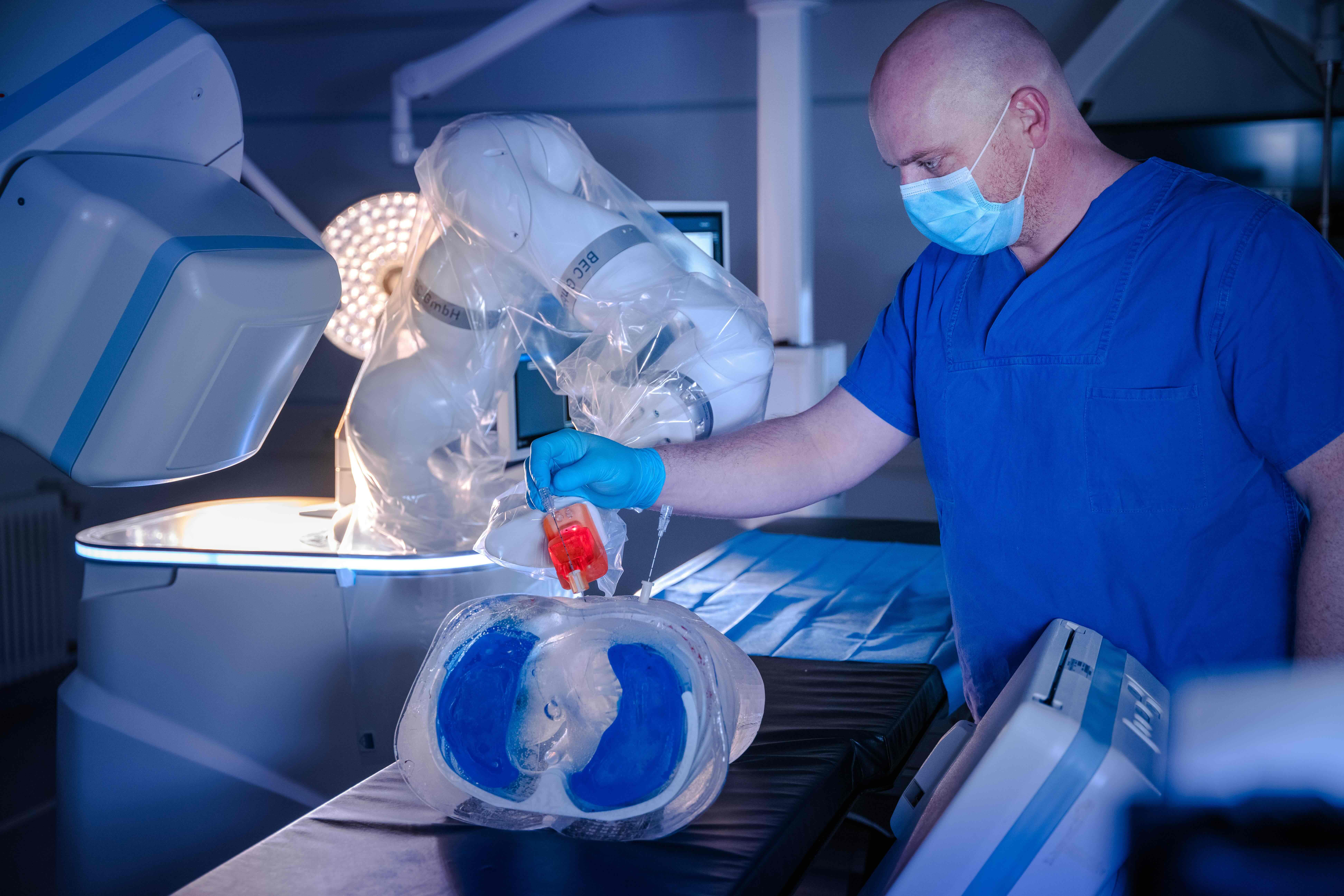 Assistive robots such as guidoo assist physicians in performing medical procedures © Fraunhofer IPA
Time is a critical factor in medical care. Consequently, many innovations aim to accelerate examinations, surgical procedures and diagnostic processes. For example, the guidoo assistance robot, developed at the M²OLIE Research Campus in Mannheim, supports physicians by positioning and aligning biopsy needles.24) This not only shortens the procedure but also improves precision and enhances patient safety.25)
The EEG caps developed by Tübingen-based Cerebri GmbH likewise enable rapid and straightforward neurological examinations. Combined with AI-supported telemedical analysis, this diagnostic could in future also be made available outside specialised centres.26) Meanwhile, the Tübingen-based company dxOmics has used AI to reduce the time required for genome analysis from four to six weeks to around one hour. 27)
Surgeons also receive physical support from the noac assistance system developed by Hellstern medical GmbH in Wannweil. This exoskeleton, which is already in widespread clinical use and has been selected for NATO’s DIANA innovation programme, stabilises the surgeon’s posture and reduces physical strain. As a result, this alleviates fatigue while improving precision and overall performance.28)
AI-supported imaging is also expanding the possibilities in surgery. For example, a multispectral imaging system developed in Heidelberg analyses tissue oxygen saturation in real time, enabling continuous, non-invasive monitoring of tissue perfusion during surgical procedures.29) Furthermore, deep learning algorithms can be used to analyse hyperspectral images of the palm and ring finger to enable the rapid, straightforward and reliable diagnosis of sepsis.
Validation and transparency are required
The benefits of AI-based solutions depend largely on rigorous validation of the algorithms they employ. Algorithms must be trained and evaluated using high-quality datasets and appropriate performance metrics to ensure that their outputs are reliable, accurate and clinically meaningful. The online tool Metrics Reloaded, developed by an international consortium led by researchers in Heidelberg, supports the selection of the most suitable evaluation metrics for different image analysis tasks, thereby improving the quality, robustness and comparability of AI-based results.30)
Transparency is also essential for the acceptance of AI in clinical practice. The skin cancer diagnostic system developed at the DKFZ helps physicians understand how a diagnosis is reached by identifying the key image features that contributed to its decision. Explainable artificial intelligence (XAI) increases trust in AI-assisted decision-making and also physicians’ diagnostic confidence.31) The Hetairos tumour classification system goes a step further by indicating the level of confidence associated with each prediction and suggesting several likely diagnoses, thereby supporting more informed clinical decision-making.8)
The medicine of tomorrow
 Artificial intelligence can dramatically accelerate and improve the analysis of medical data. © kp yamu Jayanath on Pixabay
AI and robotics are set to make healthcare more efficient, more precise and more patient-centred. By reducing the administrative and routine workload of healthcare professionals, these technologies free up more time for personalised patient care. At the same time, AI-supported methods enable more tailored diagnoses and treatments by taking individual patient characteristics into account to a far greater extent than conventional standardised approaches. The comprehensive analysis of health data also strengthens disease prevention and enables earlier detection. Overall, these advances have the potential to improve the quality of care while reducing healthcare costs in the long term.
Robotics and automation are accelerating research and development while increasing the efficiency of manufacturing processes. For example, cell-based personalised therapies, currently produced through numerous manual steps, can be manufactured more cost-effectively and made accessible to a broader patient population. In order to realise their full potential as long-term drivers of innovation and growth in healthcare, these technologies must be developed from the outset with resource efficiency as well as environmental and social sustainability in mind.
Looking further ahead, the vision for AI and robotics in healthcare is even more ambitious. Smart cognitive operating theatres could automatically document surgical procedures, independently adjust lighting conditions and provide surgeons with relevant patient information in real time.32) Simulation technologies will also play an increasingly important role. Biomechanical models, for example, can optimise the fit of artificial joints before implantation, while digital twins enable treatments to be tailored to individual patients and help detect secondary damage at an early stage. 33)34) Micro- and nanorobots could further expand the possibilities of minimally invasive medicine by enabling highly targeted drug delivery, supporting diagnostic procedures and assisting in the treatment of tumours. 35)36)
When used responsibly, these innovative technologies have the potential to transform healthcare by improving access, quality and efficiency – both in highly developed healthcare systems and in regions that have long been underserved.
