A revolution in glass processing technology for the medical technology sector
The Freiburg-based start-up Glassomer is rethinking materials
Glassomer has developed an innovative process for producing pure quartz glass. The result is geometrically complex glass components with micrometre-level precision that can be reproduced consistently at a fraction of the energy cost of conventional glass-melting processes. The company focuses in particular on customised products for diagnostic, therapeutic and microfluidic applications.
Glass is one of the most versatile materials. Its properties – chemical inertness, optical transparency, thermal stability, biocompatibility and scratch resistance – make it indispensable for numerous high-tech applications. However, it has one major drawback: glass can only be produced and shaped using enormous amounts of energy at temperatures exceeding 1,600 °C. Microstructures are then created using corrosive acids, while minute lenses require painstaking grinding and polishing. Complex, delicate geometries – such as those required in modern medical technology, optics and microfluidics – are therefore difficult to produce using conventional glass manufacturing processes.
Until now, that is. The Freiburg-based start-up Glassomer GmbH has developed a groundbreaking technology that enables transparent glass to be injection-moulded and 3D-printed at temperatures as low as 130 °C, significantly reducing energy consumption – while using standard plastic-processing machines.
Processing glass just like plastic – only better
At the heart of this innovation lies a novel composite material: Glassomer®, which consists of high-purity silicon dioxide nanoparticles just a few nanometres in diameter – around 2,000 times thinner than a human hair. These nanoparticles are embedded in a polymer carrier matrix. What makes the process particularly remarkable is that, in the final stages, the products are debound and sintered, resulting in components made of 100 percent pure quartz glass. At the same time, the technology can be used to produce extremely delicate structures. This represents a paradigm shift, especially for the medical technology industry.
Glassomer was founded in 2018 as a spin-off from the Karlsruhe Institute of Technology (KIT) and brings extensive expertise in process engineering to its product development. "Our material is available either as solid granules or as a liquid resin and is compatible with a wide range of processes, from injection moulding and additive manufacturing to traditional subtractive methods such as drilling and milling. The process can be carried out using the same machines as those used for polymers," explains founder and managing director Dr. Frederik Kotz-Helmer. The 20-strong team has thus achieved something that was long considered impossible: glass that can be shaped like plastic – while consuming 80 percent less energy and significantly reducing its carbon footprint. But how does it work?
"Whereas conventional glass melting requires temperatures of 1,600 °C, our material is liquefied at just 130 °C and injected into a mould. The carrier matrix is then removed in a subsequent debinding step. The high-purity, transparent quartz glass is produced at 1,300 °C during the final sintering stage. Our process exploits the effect whereby surface forces draw the particles together, enabling us to reduce temperatures by 60 percent compared with conventional quartz glass melting."
Design freedom – a gateway to the growing MedTech market
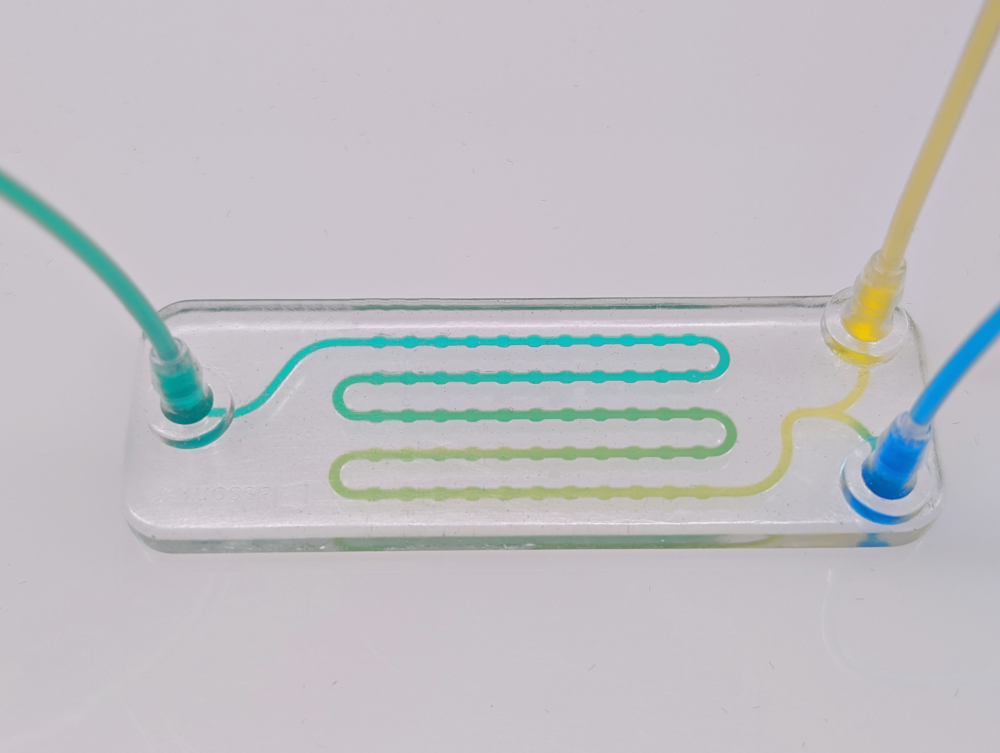 Chip with a 3D-printed microfluidic channel made of quartz glass. © Glassomer GmbH
While Glassomer® technology already caters for a wide range of applications – including fibre optics and data communication, precision optics for cameras and smartphones, and specialised products for the cosmetics industry – medical technology is another significant field with considerable potential. Here, glass offers decisive advantages over plastics: it is biologically inert, UV-transparent, chemically resistant to aggressive reagents and does not generate background signals in spectroscopy.
It is technically possible to make components thicker than 9 mm, but these are not currently being envisaged due to the nature of the process – the business model is deliberately geared towards high-purity, precision applications. The technology really comes into its own with the smallest details. "The injection moulding process enables us to produce extremely fine microstructures and channels," says Kotz-Helmer, highlighting the almost limitless design possibilities. "We replicate the surface of the desired component. It would not be possible with conventional etching or grinding processes to produce such intricate structures with the same level of precision and design freedom."
Lenses, implants, micro-lab chips – tiny components with huge potential
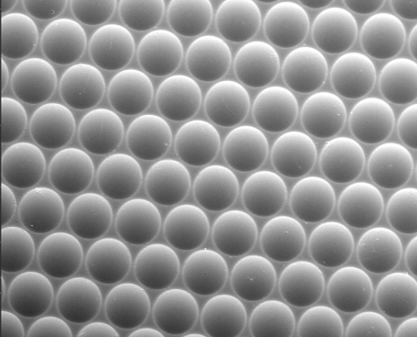 Tiny micro-optics made from quartz glass, produced using an injection moulding process. © Glassomer GmbH
One highly relevant area of medical technology is miniaturised optics for endoscopic applications. High-precision glass lenses with complex geometries – previously manufactured only in very small batches and at considerable cost – could be produced cost-effectively, in the quality and quantity required, using the Glassomer® process. Kotz-Helmer explains the advantages: "Endoscope lenses manufactured using our process offer excellent light transmission and high image sharpness. They are also heat-resistant and easy to sterilise."
Thanks to their biocompatibility and autoclavability, Glassomer® glasses are suitable for applications such as housing components, elements of optical biosensors and nozzles for targeted delivery of active substances. Another important field of application is lab-on-a-chip and organ-on-a-chip technology. These miniaturised microfluidic systems are used to automatically perform chemical, biological and drug analyses with very small sample volumes, as well as to replicate structural and functional properties of human organs on a chip. This is an area of application where Glassomer® microsystems are particularly user-friendly: mini Luer-lock connectors can be injection-moulded or printed directly onto the chips, allowing pump tubing to be connected without requiring additional components.
The scalable production of complex microfluidic glass chips opens up further applications, including point-of-care diagnostics for portable devices used to analyse blood, urine or saliva at the point of patient care. In molecular biology, the optical purity and thermal stability of the glass benefits DNA/RNA amplification and sequencing as well as the dispensing of minute volumes of liquid through fine nozzles. Kotz-Helmer highlights another key property: "Even sudden temperature changes cannot damage Glassomer® nozzles: every second, liquid is heated, evaporated, cooled and reheated. While conventional glass would crack under such conditions, our material has a coefficient of thermal expansion that is 20 times lower and therefore remains stable."
Tailor-made solutions for specialised requirements
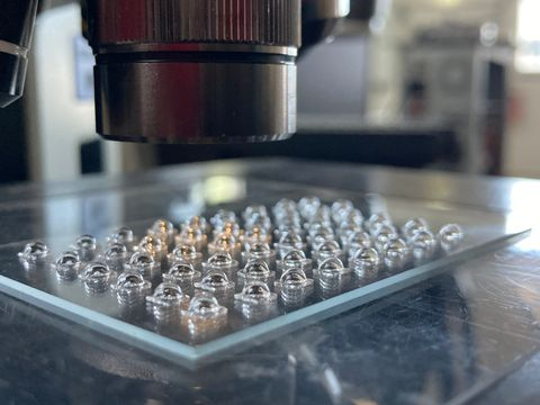 Quartz glass LED lenses for disinfection using UV light. © Glassomer GmbH
The flexibility and scalability of the patented Glassomer® technology place the Freiburg-based team in a unique position in the glass-processing sector. EU funding under the Horizon 2020 programme helped the company bring its technology to market. The interdisciplinary team has also received numerous awards for its technological and scientific achievements, with its research published in prestigious scientific journals such as Nature and Science.
"It is crucial to consider the entire process chain," explains Kotz-Helmer. "The advantage of our technology compared with a simple glass lens lies notably in the integration of multiple functions. If, for example, optical and structural functions are combined in a single component, additional components can be eliminated, along with subsequent assembly and processing steps." The company runs its own production facility in Freiburg that has several injection moulding lines, and already serves well-known industrial clients. It is currently in the scale-up phase: the technology has been validated, initial customers have been secured and the first batches have been delivered. "The focus now is on expanding our production capacity and tapping into further market segments – particularly in medical technology," says Kotz-Helmer. "In this regard, we would like to create better networking with small and medium-sized enterprises so we can work with their technical experts to develop solutions to specific problems. Often, we are simply unaware of each other’s existence. Funding for companies wishing to trial new technologies in an initial proof-of-principle phase would also be very welcome."
It is specialist solutions that make all the difference, with microstructures paving the way for major technological advances.
