CRISPR base editing for tailored tumour treatment
Targeted genetic manipulation of signal transduction pathways in CAR T cells enhances anti-tumour potency
Chimeric antigen receptor (CAR) T cell therapy has emerged as a highly promising treatment modality but has so far been used almost exclusively for advanced haematologic malignancies. Researchers at the iFIT cluster of excellence in Tübingen have now used CRISPR base-editing technology to introduce precise point mutations into key signalling pathways of CAR T cells, significantly enhancing their long-term persistence and anti-tumour potency against solid tumours.
CAR T cell therapy has been approved in Europe since 2018. It offers a promising chance of cure for certain types of blood cancer, even in patients for whom chemotherapy and stem cell transplantation have failed. It works by genetically engineering a patient’s own T lymphocytes to recognise and eliminate characteristic markers on tumour cells. However, this type of personalised treatment is time-consuming and expensive and can also lead to severe side effects. Moreover, it has so far shown limited potency against solid tumours, which are cancers that arise in solid tissues and account for the vast majority of cancer cases.
Tailored tumour recognition
 Philip Bucher and other members of the research groups led by Prof. Judith Feucht and Junior Prof. Dr. Josef Leibold are specifically introducing genetic modifications into the signalling pathways of CAR T cells to promote the formation of long-lived memory cells and thereby enhance therapeutic effectiveness. © P. Bucher
Whereas antibodies secreted by B lymphocytes target structures outside or on the surface of cells, T lymphocytes detect changes occurring within them, whether as a result of viral infection or mutations. This is because HLA (human leukocyte antigen) class I molecules bind short peptide fragments derived from intracellularly synthesised proteins and present them on the cell surface. If pathogen-specific or abnormal proteins are produced within the cell, corresponding peptides that are foreign to the body (known as non-self peptides) are displayed on HLA molecules and can be recognised by T lymphocytes via their T-cell receptor (TCR). If a co-stimulatory signal is also provided, for example through the surface protein CD28, this triggers a cytotoxic immune response.
However, tumour cells can evade the immune system by downregulating the number of HLA peptide complexes on their surface. CAR T cell therapy therefore combines functional properties of B and T lymphocytes, enabling HLA-independent recognition of cancer cells. This involves genetically modifying a patient’s own (autologous) T lymphocytes to express a synthetic chimeric antigen receptor (CAR) on their surface. The receptor consists of an antibody-like recognition domain capable of binding specific proteins (antigens) on tumour cells. A transmembrane region connects the recognition domain to a co-stimulatory signalling domain and a TCR domain required for signal transduction. As a result, antigen recognition by the CAR alone is sufficient to trigger a cytotoxic signalling cascade.
Despite high initial response rates, the long-term efficacy of the therapy is unfortunately often insufficient. "We are working to improve the efficacy of CAR T cells and extend their application to solid tumours," explains Dr. Philip Bucher from Prof. Dr. Judith Feucht’s Cellular Immunotherapies for Cancer group at Tübingen University Hospital. As part of research funded by the 'Image-guided and Functionally Instructed Tumour Therapies' (iFIT) cluster of excellence, signalling pathways within immune cells are being investigated and manipulated. The aim is to promote the development of long-lived memory cells in the body and thereby improve CAR T cell therapy.
The PI3K signalling pathway as a starting point for targeted fine-tuning
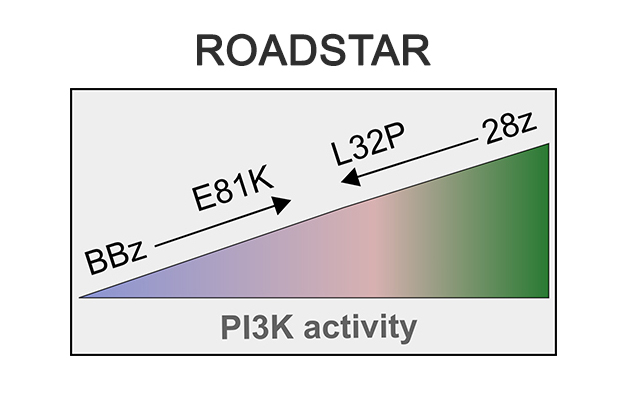 The ROADSTAR platform is used to introduce precise genetic modifications into cells. The E81K mutation in BB-CAR T cells (BBz) and the L32P mutation in 28-CAR T cells (28z) regulate the activity of phosphatidylinositol 3-kinase (PI3K) in both cell types to a moderate level.
Source: https://doi.org/10.1038/s43018-025-01099-7, P. Bucher, CC-BY 4.0 (https://creativecommons.org/licenses/by/4.0/), modified by R. Menßen-FranzTo this end, the researchers collaborated closely with the Functional Immunogenomics group led by Junior Professor Dr. Josef Leibold, employing a novel technique known as CRISPR base editing. This method enables targeted introduction of point mutations into the cellular genome. The team focused on the PI3K/AKT (phosphoinositide 3-kinase/protein kinase B) signalling pathway, which is active in all body cells and plays a central role in regulating the cell cycle, making it essential for growth and differentiation. Depending on the tissue type, different isoforms of the PI3K enzyme are expressed; in lymphocytes, for example, PI3Kδ is the dominant isoform.
The activation of PI3Kδ by the CD28 molecule is crucial for the proliferation and maturation of T lymphocytes following antigen contact, which is why many CAR constructs contain the co-stimulatory domain of this protein. Alternatively, a functional domain of the 4-1BB (CD137) protein is used, which triggers a different proliferation-promoting signalling cascade via, amongst other things, the transcription factor NF-κB.
"To modulate PI3Kδ activity, we specifically targeted the region of the catalytic subunit that interacts with the regulatory subunit," explains the biochemist. "Using our ROADSTAR platform (Rational Optimisation of Activation-dependent Signalling via Targeted Allelic Reprogramming), we were able to generate a pool of mutated cells for each of the two CAR variants. Subsequent stimulation with tumour cells then enabled us to identify two particularly interesting point mutations."
The aim is functional persistence
The results were published in early 2026 and are promising.1) Substituting the amino acid leucine at position 32 with proline (L32P) in CAR T cells containing a CD28 co-stimulatory domain (28-CAR T cells) attenuates PI3Kδ signalling. This increases the cells’ proliferative capacity and reinforces their long-term anti-tumour effect. The researcher explains: "The initial response to CAR T cell therapies is often very good. But when the tumour returns after a few years, there are hardly any memory cells left to control it. Through this mutation, we increase functional persistence. This means that after initial contact with the antigen, the cells do not differentiate as strongly and become less exhausted, so that they can proliferate more effectively and attack tumour cells upon renewed contact."
Compared with 28-CAR T cells, those with a 4-1BB co-stimulatory domain (BB-CAR T cells) have an inherently lower effector function and are more prone to differentiate into memory cells. Substituting glutamic acid at position 81 with lysine (E81K) in these cells enhances PI3Kδ signalling, thereby increasing initial cytotoxicity against tumour cells. In animal models, they also provide stronger long-term protection.
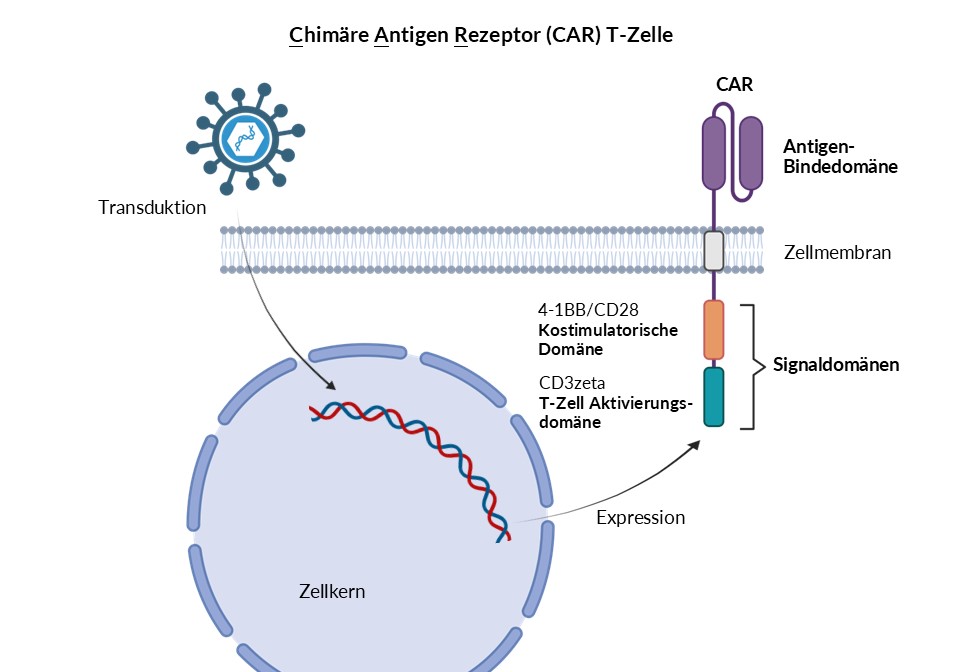 Using viral vectors, the DNA-encoded genetic blueprint for the chimeric antigen receptor (CAR) is introduced into the patient's autologous T cells (transduction). The CAR, which is anchored in the cell membrane, consists of an extracellular antigen-binding domain and intracellular signaling domains. © P. Bucher, made with BioRender.com
Hope for the treatment of solid tumours
The effects of both mutations were investigated in a leukaemia model and in animals with metastatic neuroblastoma, a highly aggressive solid tumour. Due to their improved functional persistence, these engineered CAR T cells were also significantly superior to current approaches in this context. The results clearly demonstrate that targeted molecular interventions in cellular signal transduction pathways can substantially enhance the effectiveness of CAR T cell therapy, opening up new therapeutic prospects.
The groups led by Feucht and Leibold are both funded by iFIT, Germany’s only cluster of excellence in oncology. More than 200 researchers work closely together in the fields of functional target identification and molecular tumour therapies, immunotherapies and molecular and functional multiparametric imaging. These collaborations, together with outstanding technical facilities, facilitate the application of innovative methods to new research questions, which provides a basis for particularly complex research.
Infobox: CRISPR base editing
Unlike CRISPR/Cas9 gene-editing 'scissors', which introduce double-strand breaks at a target DNA sequence to enable nucleotides to be inserted or removed, CRISPR base-editing technology modifies only a single DNA strand. In this system, a modified Cas9 endonuclease is fused to a deaminase, which removes an amino group from a nucleotide on the strand opposite the nicked site. Cytosine is thereby converted to uracil, while adenine is deaminated to inosine. The resulting mismatch (U:G or I:T) is then either repaired by the cell’s endogenous repair machinery or resolved into a permanent base-pair change (T:A or G:C). Depending on which strand is targeted via the guide RNA, a wide range of base substitutions can, in principle, be achieved.
