Quantum sensors for magnetic measurements
New insights into muscle physiology – contactless and three-dimensional
Contactless measurement of muscle activity and training effects: using highly sensitive quantum sensors, researchers at the Universities of Tübingen and Stuttgart are setting new standards. This technology has the potential to revolutionise clinical diagnostics and optimise training and neuroscience research.
Muscle fatigue affects many people. This may be due to neurological diseases, the consequence of an accident or sports activities. What exactly happens in the muscle when muscle force decreases, and what are the underlying mechanisms? Is it possible to detect muscle fatigue early, even before someone becomes aware of it themselves? An interdisciplinary team of researchers from Tübingen and Stuttgart are providing new insights. They are using quantum sensors to measure the biomagnetic activity of muscles and have discovered how the conduction velocity of signals changes during fatigue. What is remarkable is that because the measurements are fully contactless, they save time and are pain-free as well as repeatable. This is possible because the electric currents that flow when a muscle is active generate tiny magnetic fields. Although the signals are extremely weak, they can be measured using quantum sensors.
A new way of measuring muscle activity using magnetomyography
 Prof. Dr. Justus Marquetand is a neuroscientist, neurologist, and research group leader at the Universities of Tübingen and Stuttgart. © Marquetand
The velocity at which these weak signals are conducted along muscle fibres – known as muscle fibre conduction velocity (MFCV) – is an important diagnostic parameter. Reduced MFCV might be a sign of muscle fatigue, muscle loss or nerve damage. In addition, trained muscles conduct signals faster than untrained ones, so MFCV measurements can be used in a targeted way to track training progress and rehabilitation.
"Electromyography (EMG) is a technique used to measure muscle activity," explains Prof. Marquetand, who heads up the Magnetomyography working group at the Hertie Institute of Clinical Brain Research in Tübingen, and also works as scientist at the University of Stuttgart. However, EMG has its limitations: the skin needs to be prepared and the electrodes be applied. This is a time-consuming process and can cause skin irritations. In addition, invasive EMG using needle electrodes – often used in clinics to diagnose neuromuscular diseases – is quite painful and not tolerated by everyone, especially children. Marquetand therefore sought alternatives by developing new, faster methods that are pain-free and contactless while still providing the same or complementary information as established EMG methods. "Since electrical currents generate magnetic fields, conduction velocity can also be measured contactless using magnetomyography (MMG). The core of the system is quantum sensors," he says.
A new generation of quantum sensors
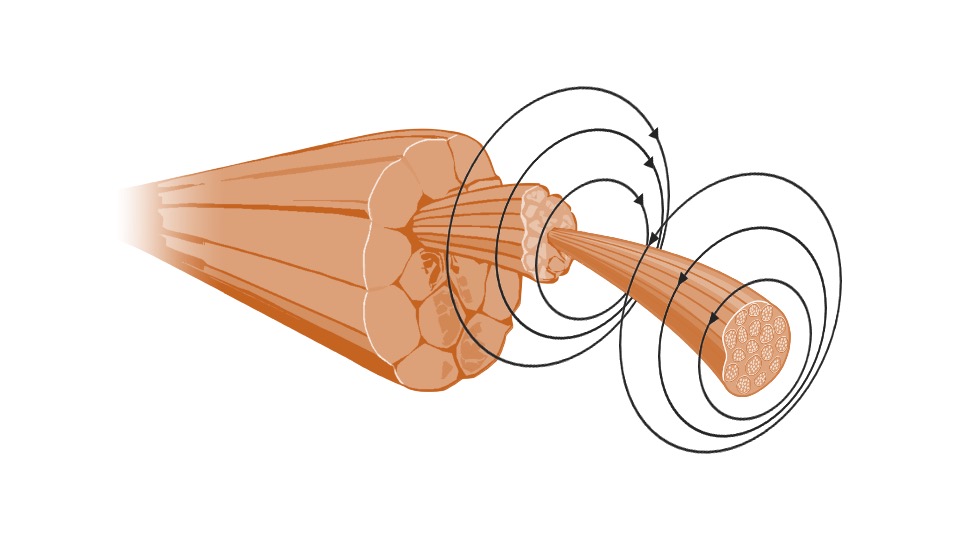 The electrical activity of muscle cells within a muscle fibre generates a magnetic field. © Marquetand
When it comes to quanta, the scientist – who did his habilitation (ed. note: habilitation is a postdoctoral qualification involving several years of research and teaching, traditionally required for obtaining a professorial position at German universities) on ‘quantum sensing applications in clinical neurophysiology’ prefers to remain down-to-earth: "I think the term 'quantum leap' is misleading. A quantum exists outside of our everyday experience – it is in fact the smallest unit of a quantity." Smallness is therefore fundamental. While electrophysiology signals are typically in the range of 10⁻⁴ (one ten-thousandth), various quantum phenomena enable measurements in the range of 10⁻¹² (one trillionth). Quantum sensors play a key role here.
The idea itself is not entirely new: magnetomyography was first demonstrated back in 1972 by two researchers who used biomagnetic sensors called superconducting quantum interference devices (SQUIDs) to record magnetic fields from human skeletal muscle. SQUIDs are considered the gold standard for highly sensitive magnetic measurements but require cryogenic cooling to -268 °C. This requires large, rigid systems like those used to measure brain activity. Marquetand mentions another sensor technology being explored at the University of Stuttgart: "Nitrogen-vacancy (NV) centres, i.e. atomic defects in diamond crystals, are highly innovative, but they have not yet achieved the sensitivity required for MMG." Optically pumped magnetometres (OPMs) are more promising for Marquetand’s studies. These extremely sensitive quantum sensors allow high-resolution measurements of weak magnetic fields without the need for cryogenic cooling. The sensors can therefore be as small as a thumb and can be flexibly positioned on the muscle of interest.
Better disease detection
Contactless, precise insights into neuromuscular health have huge potential, especially in paediatrics. As the measurement is contactless and pain-free, it is well tolerated by children. This allows neuromuscular changes to be detected early and treated more effectively.
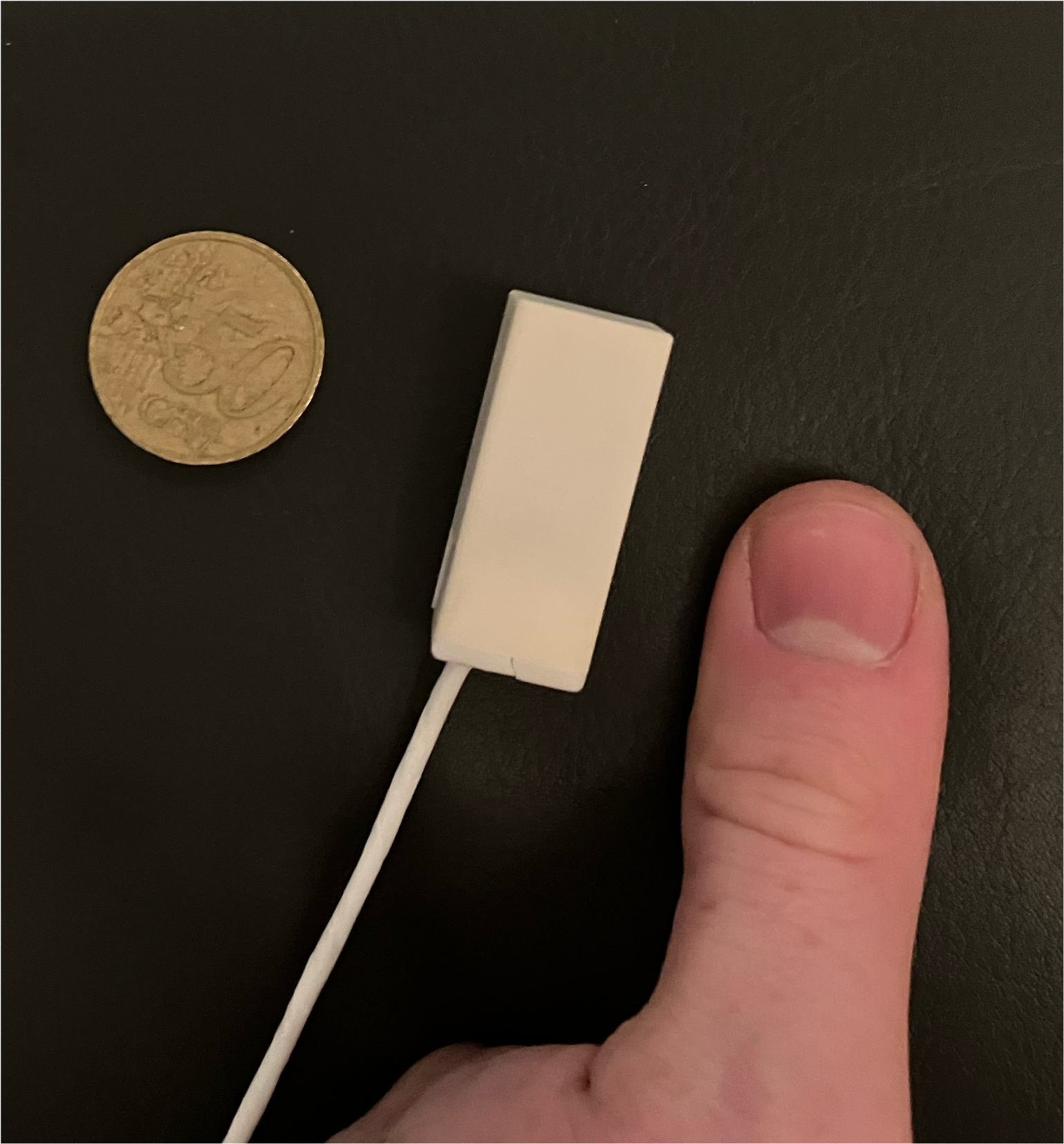 Thanks to its extremely compact design, the quantum sensor can be positioned flexibly on the muscle. © Marquetand
Last year, the team led by Marquetand published several studies, two of which are of particular importance. In the first study, the researchers demonstrated for the first time that muscle fibre conduction velocity can be measured magnetically using OPM sensors and that the innervation zone of a muscle – the region where nerve endings connect to muscle fibres – can be localised without contact.
This study also confirmed that the principle of measuring muscle fibre conduction velocity is valid. It is based on the propagation of electrical activity induced by motor neurones in the muscle fibres they innervate. These potentials propagate along the surface of the muscle fibres in both directions, starting from the innervation zone. The researchers also observed that conduction velocity increases as muscle force increases. The magnetic method therefore produces results comparable to EMG, and, crucially, is contactless. These findings pave the way for further developments and the use of quantum sensors in clinical neurophysiology.
Spatial imaging reflects muscle anatomy
In a second study, volunteers trained their biceps over a period of four weeks, during which neuromuscular adaptations to strength training were monitored. "In a multimodal experimental design combining OPM, MMG, EMG and force measurements, we were able to show that the contactless method produced results comparable to established EMG," says Marquetand. The key advantage: signal source and sensor are separate. Maximum signal amplitude is detected when the sensor’s axis is perpendicular to the muscle fibre direction, allowing up to three times more information to be obtained than with a skin electrode. Muscle fibres act like cables in which the electrical current generates a magnetic field. "The orientation of the fibres – and thus their spatial structure – can essentially be reconstructed from the magnetic field that is measured," he explains.
Without going into technical detail, hand muscles could, for example, selectively control multiple sensors, thereby enabling applications for contactless and potentially more precise prosthetic control, as the MMG signal appears to contain more information than EMG. Beyond the ability to monitor therapeutic progress, MMG has the potential to provide additional insights into muscle health relevant to age-related muscle loss, athletic performance, diabetic neuropathy and other chronic conditions. It may also enable neuromuscular diagnostics for patients who cannot undergo EMG. However, Marquetand also sees some challenges: "The technology still needs to become more sensitive, robust and affordable, with reduced noise."
Future cluster QSens: Baden-Württemberg as a pioneer in quantum sensing
Other potential challenges, according to Marquetand, are the high levels of bureaucracy, limited digitalisation as well as limited application and funding opportunities. "Stronger networking between clinics and research institutions is also crucial in order to advance diagnostics and therapy in a targeted way," he points out. One example of successful collaboration is the BMFTR-funded future cluster 'Quantum Sensors of the Future (QSens)', in which universities, research institutions and industry partners work together on innovative sensor solutions to reinforce Germany’s leading role in quantum sensing.
